Introduction
Over the past few decades, marketing has changed quickly, progressing from straightforward radio jingles and billboards to intricate digital strategies. However, the emergence of cutting-edge technologies and the growing desire for greater personalization are now surpassing even digital marketing, which was once thought to be revolutionary. It is useful in this situation.
Quantum marketing, which was created and made popular by Raja Rajamannar, CMO at Mastercard, is more than just a catchphrase; it’s a paradigm shift. It adopts a fresh way of thinking that combines creativity, science, and technology to develop marketing plans appropriate for the complexity of the contemporary world. 72% of consumers expect brands to be aware of their specific needs, according to Salesforce. This blog will discuss the definition of quantum marketing, its significance, and how it is transforming brand communication.
What is Quantum Marketing?
By providing AI-driven marketing strategies that go beyond conventional personalization, Quantum Marketing is influencing the direction of digital marketing. It alludes to a sophisticated, multifaceted marketing strategy that makes use of cutting-edge technologies like blockchain, quantum computing, augmented reality, virtual reality, and artificial intelligence. Quantum Marketing uses AI-powered tools that adjust in real-time to make hyper-personalized marketing a reality.
In short, it is about marketing that is more aware of the consumer than ever before—reacting to their actions in real time, anticipating their needs, and establishing a profoundly human connection with them through the harmonious use of technology, emotion, and data.
The Evolution of Marketing from Conventional to Quantum
Phases are the best way to understand how marketing evolves:
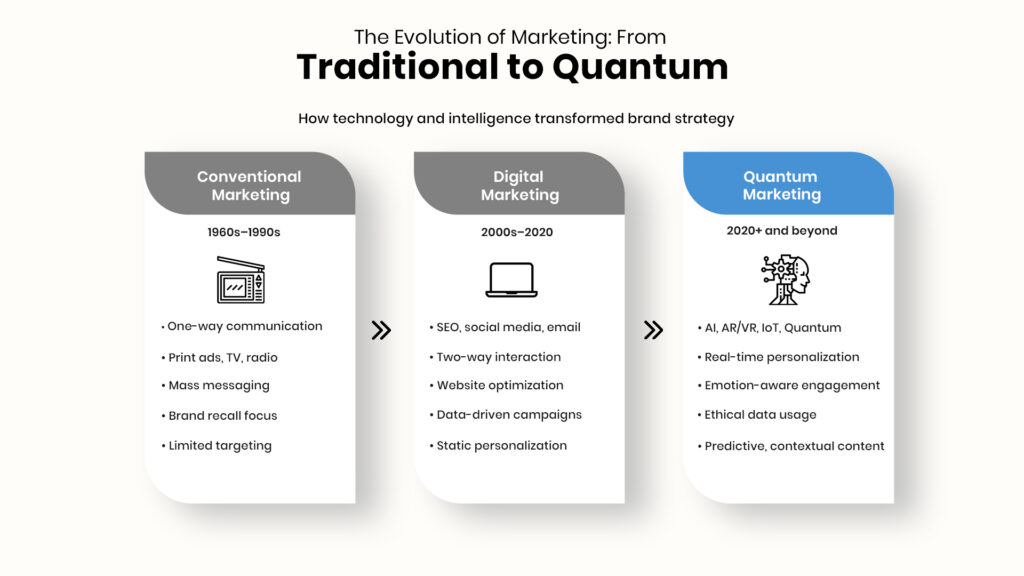
Conventional Promotion
One-way communication through radio, print, and television was the main focus of this phase. With little audience interaction, the objective was brand recall and widespread awareness.
Internet-Based Promotion
Two-way communication, SEO, email campaigns, social media engagement, and website optimization were all made possible by digital marketing. Even though it was more dynamic than conventional methods, it still mostly relied on campaign-based thinking and pre-established customer personas.
The Quantum Marketing Era
Both are outperformed by quantum marketing because it allows :
- Personalization in real time
- AI-powered predictive analytics
- Content that is emotionally charged
- AR/VR immersive experiences
It is now about engaging in intelligent, continuous dialogue with your audience rather than just broadcasting a message.
Fundamentals of Quantum Marketing
1. Technology-Driven Approach
Utilizing technologies like artificial intelligence (AI), machine learning, quantum computing, and the Internet of Things (IoT) is central to quantum marketing. With the aid of these tools, marketers can conduct micro-level analyses of consumer behavior and develop responsive rather than reactive strategies.
AI, for example, can analyze millions of data points to forecast a user’s likely next move. Quantum computing is still in its early stages, but it has the potential to significantly accelerate data analysis and decision-making.
2. Hyper-Personalization
The days of classifying audiences into large groups are long gone. Brands are able to customize their offers and messaging to the individual level thanks to quantum marketing. Customers receive content that is specifically relevant to them, whether through dynamic pricing, customized emails, or carefully chosen product recommendations. Companies that employ hyper-personalization report up to 20% gains in sales.
Based on browsing patterns and behavioral data, a customer looking for hiking shoes might instantly see a customized landing page with trekking gear, suggested blogs, and travel destinations.
3. Emotionally Intelligent Engagement
Quantum Marketing is emotionally aware. Brands use tools like:
- Facial recognition
- Biometric sensors
Emotional feedback in real time
Brands that use emotion-driven experiences see an increase in customer retention of over 80%, according to Deloitte. A fitness app, for instance, can identify weariness and immediately recommend inspirational material. Through engagement that is sensitive to emotions, this improves the user experience.
4. Conversational and Contextual Experiences
Customers of today anticipate prompt responses. Voice assistants, chatbots, and real-time content delivery driven by AI have become indispensable. This is furthered by Quantum Marketing, which dynamically customizes each message by utilizing contextual information such as location, time of day, weather, and previous interactions.
For example, when the temperature in the user’s location falls below 10°C, a coffee company may send a mobile notification offering a hot beverage.
5. Ethical Data Use
In the era of data, trust is essential. The ethical and transparent use of customer data is emphasized by quantum marketing. Informed consent must be obtained, sensitive data must be anonymized, and the use of data must be made transparent by brands. In light of growing privacy concerns, this principle is not only a good idea, but also essential.
Why the Future Is in Quantum Marketing
The field of marketing is getting more and more complicated. Through a network of touchpoints, including social media, wearable technology, smartphone apps, and smart speakers, consumers engage with brands. They now expect real-time, context-aware interactions instead of generic messages.
- In order to manage this complexity, quantum marketing is made to:
- Providing experiences that are emotion-aware and data-rich
- Real-time adaptation to changes
- Increasing transparency to foster greater trust
- Using AI analytics to provide quantifiable results
Ignoring these developments puts brands at risk of becoming obsolete. McKinsey claims that businesses that customize experiences can outperform rivals in terms of revenue by 40%. Conversely, companies that use Quantum Marketing will build closer relationships with their audience, increase customer loyalty, and achieve unprecedented levels of productivity and return on investment.
Real-World Examples of Quantum Marketing in Action
Mastercard
A potent illustration of sensory branding in action is Mastercard’s “Sonic Brand Identity.” Additionally, the business uses AI-powered data to customize financial services and immersive advertising campaigns that combine augmented reality and in-store experiences.
Nike
Nike uses augmented reality (AR) in their apps to let users virtually try on shoes. The brand offers a highly customized and captivating experience when paired with AI-driven fitness recommendations.
Netflix
Netflix offers personalized content recommendations by using machine learning to analyze user preferences. This strategy greatly increases user retention and satisfaction.
For a deeper look at how AI is transforming today’s marketing agencies, explore the guide: The Future of Marketing Agencies in 2026.
By applying the concepts of Quantum Marketing, these companies are redefining consumer interaction rather than just experimenting.
Putting Quantum Marketing Into Practice: A Comprehensive Guide
- Upgrade Technology: Make use of cloud CRM, analytics platforms, and AI-compatible tools.
- Gather First-Party Data: Pay attention to information obtained through loyalty programs, forms, and apps.
- Upskill Teams: Receive instruction in UX, data literacy, and behavioral psychology.
- Use chatbots, feedback loops, and dynamic content to interact in real time.
- Try gamified advertisements, VR demos, and AR filters to test immersive formats.
Is Quantum Marketing Only a Fad?
According to critics, quantum marketing might just be a catchphrase based on already-existing technology. But the mindset change is more important than the tools.
Quantum marketing is a framework that integrates science, creativity, and empathy. It is improving traditional marketing for a more connected and complex world, not replacing it.
When applied correctly, it results in:
- Stronger brand trust
- Deeper customer relationships
- Increased conversion and retention rates
Therefore, it is not a trend. It is a strategic evolution.
Conclusion
Quantum Marketing is not just the future—it is the present of marketing innovation. It bridges the gap between data and emotion, science and creativity, technology and humanity.
When properly implemented, it leads to :
- Increased brand trust
- More intimate connections with customers
- Higher rates of conversion and retention
It is not a trend as a result. It is an evolution of strategy.
FAQs
1. What is Quantum Marketing and how is it different from digital marketing?
Quantum Marketing goes beyond traditional digital marketing by combining AI, emotional intelligence, and emerging technologies (like AR, VR, IoT, and quantum computing) to create hyper-personalized, real-time, context-aware brand experiences.
2. Who coined the term Quantum Marketing?
The concept was introduced and popularized by Raja Rajamannar, the Chief Marketing Officer of Mastercard, as a way to redefine marketing for today’s tech-driven, emotionally complex consumer landscape.
3. How does Quantum Marketing use AI and data differently from other strategies?
Unlike standard personalization, Quantum Marketing uses real-time AI analytics, behavioral signals, and emotional cues to predict consumer needs and deliver dynamically tailored content, experiences, and messaging.
4. Why is ethical data use crucial in Quantum Marketing?
Because Quantum Marketing relies on deep, often personal data, ethical use builds trust and transparency, ensuring brands respect privacy while delivering personalized value.
5. Are there real-life examples of Quantum Marketing in action?
Yes. Brands like Mastercard, Nike, and Netflix already use AI-driven personalization, sensory branding, and immersive AR/VR experiences that exemplify Quantum Marketing principles in real-world campaigns.
Final Thought
Quantum marketing is the current state of marketing innovation, not just the way of the future. It connects science and creativity, technology and humanity, and data and emotion.
Quantum marketing provides a route to increased relevance, impact, and sustainability for brands navigating the cutthroat and fragmented market of today. Marketers can make sure that their tactics are not only innovative but also closely aligned with the changing needs and feelings of their target audience by adopting its tenets.
Telling stories that connect is the essence of marketing, and Quantum Marketing makes sure that these stories are more intelligent, quicker, and relatable than ever.
The time has come for marketers to adopt Quantum Marketing—not as a fad, but as the strategic cornerstone for creating brand connections that are future-proof, data-driven, and emotional.