SEO mistakes to avoid in 2026 are becoming more critical than ever as Google’s algorithms evolve and user expectations rise. Many businesses unknowingly repeat the same errors, hurting their rankings, wasting their marketing budget, and losing valuable traffic. In this guide, we break down the biggest SEO mistakes you must avoid in 2026 and show you how to fix them with simple, actionable steps.
Even the most meticulously planned strategy can be derailed by minor errors, such as disregarding user intent or depending on antiquated techniques like keyword stuffing. We’ll go into great detail about the 15 SEO blunders you should steer clear of in this guide if you want to be successful online in 2026. We’ll explain why these errors are detrimental, how they manifest on actual websites, and how to correct them.
Why It’s Crucial to Avoid SEO Mistakes
Many businesses still struggle with the biggest SEO mistakes to avoid, and these errors directly impact rankings, traffic, and online visibility. By understanding what these mistakes are, brands can improve performance and stay competitive in the 2026 digital landscape.
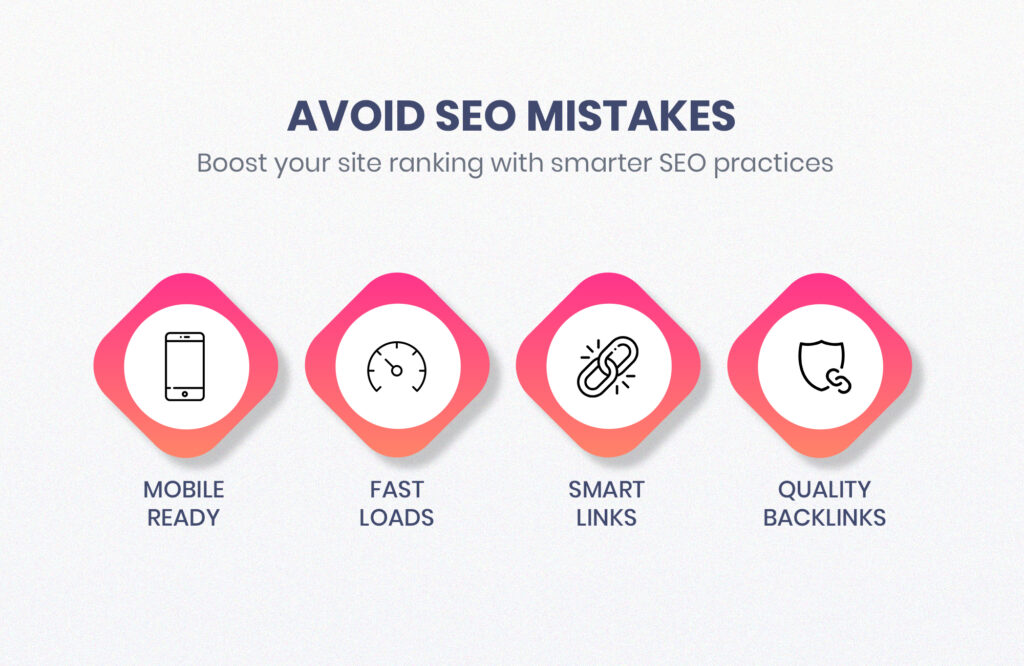
Understanding the most important SEO mistakes to avoid helps you stay aligned with Google’s ranking factors and algorithm shifts. It’s crucial to comprehend why avoiding SEO errors is crucial before delving into the list. Google and other search engines update their algorithms frequently. You run the risk of losing authority and rankings if your website isn’t optimized or, worse, if it contains numerous common SEO pitfalls like duplicate content or poor backlinks.
Focusing on error removal enhances user experience, which is central to contemporary SEO, in addition to increasing your site’s visibility.
Here are some reasons why avoiding SEO mistakes ought to be your first concern:
- Improved rankings: Avoiding errors increases your chances of showing up on Google’s first page.
- Improved user experience: Fixing errors makes your site faster, clearer, and more helpful.
- Sustainable traffic growth: Correcting common on-page SEO mistakes gives you long-term visibility rather than short-lived spikes.
- Higher ROI on content marketing: The fewer errors your website has, the more efficient your SEO investments will be.
Let’s now take a closer look at the 15 crucial SEO errors to avoid in detail.
1. Ignoring the importance of keyword research
Poor keyword research is one of the earliest SEO mistakes to avoid, especially for new websites. Ignoring thorough keyword research is one of the most frequent SEO errors to avoid. Instead of using keyword tools to confirm, many businesses target terms they believe people search for.
Why this hurts SEO
Without thorough keyword research, you run the risk of:
- focusing on search terms that receive little to no traffic.
- Competing for highly competitive keywords that established brands already dominate
- losing out on long-tail prospects that might provide conversion-ready, targeted traffic.
How to fix it
- To find primary and secondary keywords, use tools such as Ahrefs, SEMrush, or Ubersuggest.
- Always verify the purpose of the search (is it transactional, navigational, or informational?).
- Pay attention to long-tail keywords, such as “SEO mistakes to avoid for beginners,” as they typically generate higher conversion rates than generalized terms like “SEO mistakes.”
- Examine SERPs to find out what Google already offers as rewards.
By optimizing your site around these insights, you avoid one of the foundational search engine optimization errors that cost rankings.
2. Keyword Stuffing
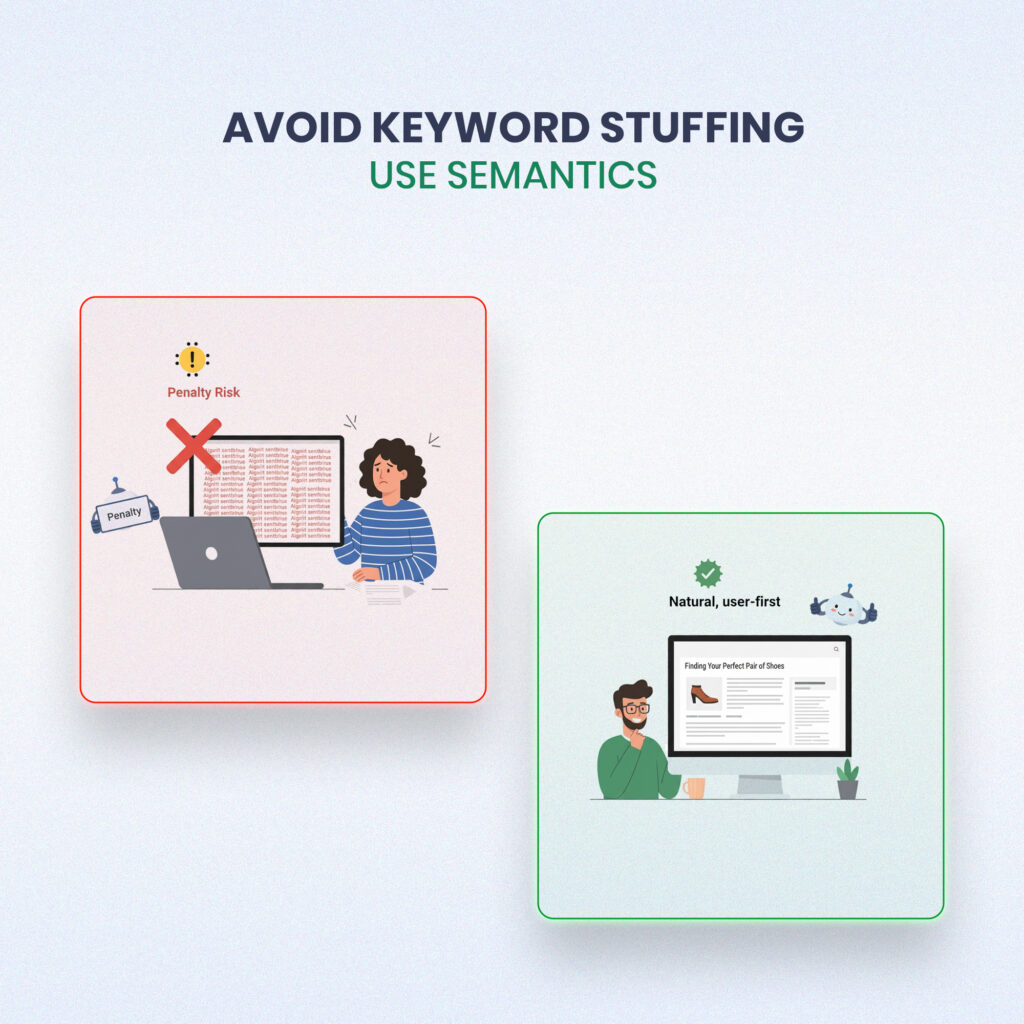
In the past, loading content with repetitive keywords could trick search engines. Today, keyword stuffing is one of the worst SEO mistakes to avoid. The antiquated technique of packing a page with your target keyword in an attempt to improve its ranking is known as “keyword stuffing.”
Why this hurts SEO
Search engines may penalize over-stuffing because it conveys spammy intent. Google’s algorithms are made to prioritize writing that is natural and user-focused.
How to fix it:
- Use your keyword naturally and in moderation.
- Use semantic keywords throughout the text, such as “SEO pitfalls,” “ranking errors,” or “on-page SEO mistakes.”
- Put readability above repetition.
Rather than repeating “SEO mistakes to avoid” twenty times, change up your language while staying on topic. This establishes authority without appearing forced.
3. Weak or Thin Content
Publishing short, generic articles is a content marketing mistake that directly impacts SEO rankings.
Why this hurts SEO
- Google prioritizes helpful, comprehensive content that fully addresses user questions.
- Thin content leads to poor engagement metrics (high bounce rates, low time on page).
How to fix it
- Aim for pillar content of 1,500–3,000 words on key topics.
- Structure your writing with H2s and H3s for readability.
- Add multimedia like infographics or videos.
- Insert statistics, case studies, and expert examples to enrich your content.
Think of content as building authority. If your article is the most complete online resource, Google will rank it higher than others.
4. Duplicate Content Issues
Duplicate content, having very similar or exact copies of content across pages—confuses search engines.
Why this hurts SEO
Search engines can’t tell which version of your page to index. This dilutes ranking signals and reduces visibility.
How to fix it
- Use canonical tags for duplicate/syndicated content.
- Merge similar articles into one authoritative piece.
- Audit your site with Screaming Frog or Copyscape to find duplicates.
- Ensure product pages with slight variations (colors, sizes) are unique where possible.
Proper handling of duplicate content prevents one of the most damaging technical SEO mistakes.
5. Not Optimizing Title Tags & Meta Descriptions
Your title and meta description are the first things users see in search results. Skipping optimization is a basic SEO mistake that drastically reduces clicks.
Why this hurts SEO
- Generic titles reduce click-through rates.
- Missing target keywords means lower keyword relevance.
How to fix it
- Title tags should contain the primary keyword (“SEO mistakes to avoid”).
- Limit meta descriptions to 160 characters and titles to 60.
- Write actionable, compelling descriptions with a benefit-driven hook (e.g., “Learn the top SEO mistakes to avoid and boost your rankings today.”).
Optimized meta elements improve both user engagement and rankings.
6. Overlooking Mobile Optimization
Google uses mobile-first indexing, meaning your site is ranked primarily based on its mobile version. Neglecting mobile SEO is among the most costly technical SEO mistakes.
Why this hurts SEO
- Mobile users leave quickly if the layout breaks or loads slowly, increasing bounce rates.
- Poor mobile usability leads to lower engagement metrics like time on page and pages per session.
- Neglecting mobile responsiveness is one of the SEO mistakes to avoid, as it directly impacts rankings and user engagement.
How to fix it
- Implement responsive design.
- Test across different screen sizes.
- Compress images and enable lazy loading.
- Avoid intrusive pop-ups that frustrate mobile users.
Mobile optimization is no longer optional, it’s mandatory if you want to avoid a sharp decline in rankings.
7. Ignoring Website Speed
A slow website is another SEO mistake to avoid because it frustrates users and impacts bounce rates. Even if your content is excellent, users will leave if your site takes more than 3 seconds to load. Website speed is a confirmed ranking factor.
Why this hurts SEO
- High bounce rates.
- Poor user satisfaction.
- Failing Google’s Core Web Vitals.
How to fix it
- Use lightweight themes.
- Implement caching plugins.
- Minify CSS and JavaScript.
- Use a Content Delivery Network (CDN).
Regularly test your site with Google PageSpeed Insights or GTmetrix. Many websites struggle because they repeat the same old SEO mistakes to avoid without understanding user intent or search behavior.
8. Bad Internal Linking Structure
Internal linking creates a structural map for search engines and distributes authority across your pages. Many underestimate the power of internal linking. Without a good structure, search engines can’t crawl effectively.
Why this hurts SEO
- Orphan pages never get indexed properly.
- A weak structure hides cornerstone content.
How to fix it
- Link to your most important “pillar” blogs.
- Use descriptive anchor texts like “SEO mistakes to avoid in 2026” instead of generic terms like “click here.”
- Ensure each article links to at least 3–5 other relevant pages.
Done right, internal linking strengthens your site’s SEO ecosystem.
9. Ignoring Backlink Quality
Backlinks remain one of the strongest ranking factors, but not all backlinks are created equal. Accepting links from spammy sources is a major off-page SEO mistake. Not all backlinks are good. Accepting low-quality or spammy backlinks is a common SEO pitfall.
Why this hurts SEO
- Spammy links can cause Google penalties.
- Low-quality links reduce your site’s credibility.
How to fix it
- Focus on quality over quantity.
- Disavow toxic links in Google Search Console.
- Guest post on reputable websites in your niche.
- Build relationships to earn natural, authoritative links.
Think: 10 links from industry leaders are better than 1,000 links from irrelevant blogs.
10. Forgetting About Image SEO
Images do more than make your site look good, they’re also a source of organic traffic. Images drive traffic through Google Images. Ignoring them is a missed opportunity.
How to fix it
- Use descriptive file names (seo-mistakes-to-avoid-guide.jpg).
- Add alt text with relevant keywords.
- Compress images to reduce load times.
- Use WebP or next-gen formats.
This fixes a huge chunk of overlooked on-page SEO issues.
11. Not Tracking Analytics and Data
One of the most common yet silent SEO mistakes is optimizing without measuring results. Many marketers put effort into content optimization but fail to track its performance.
Why this hurts SEO
Without data, you can’t see what works or what needs improvement. And You can’t improve if you don’t measure.
How to fix it
- Use Google Analytics and Google Search Console.
- Track organic clicks, impressions, keyword rankings.
- Set up goals for conversions and traffic sources.
Data gives you clarity, ensuring every change you make is evidence-driven.
12. Poor User Experience (UX)
SEO today is closely tied to UX metrics like dwell time and bounce rates.
Why this hurts SEO
- Confusing navigation frustrates users.
- Poor design decreases trust.
- High bounce rates signal poor relevance.
How to fix it
- Improve navigation and readability.
- Break content into short, easy-to-read sections.
- Ensure strong visuals and mobile-friendly design.
User experience should be at the heart of SEO strategy.
If you want to understand how brands captivate audiences and boost engagement, check my article on Hype Marketing. It explains how emotions, storytelling, and digital trends influence user behavior, a key factor that strengthens SEO performance as well.
13. Neglecting Local SEO
Small businesses that ignore local SEO put themselves at a huge disadvantage. Without Google Maps and location-focused optimization, they miss out on nearby customers actively searching for them.
Why this hurts SEO
- You lose visibility in local searches where people are ready to buy.
How to fix it
- Optimize your Google Business Profile.
- Use local keywords like “dentist in Austin” instead of just “dentist.”
- Get local reviews and citations from trusted directories.
Local SEO mistakes are especially damaging in competitive industries like restaurants, healthcare, or law firms.
14. Not Updating Old Content
Outdated content is a silent killer of rankings. Outdated blogs, statistics, and tools signal irrelevance to search engines.
How to fix it
- Regularly refresh old articles.
- Update outdated stats with current data.
- Add new insights or case studies.
- Re-promote updated content across channels.
Even evergreen content should be refreshed every 6–12 months.
15. Not Having a Secure Site (HTTPS)
Still running HTTP? That’s a rookie technical SEO issue. Running HTTP instead of HTTPS is both a ranking issue and a trust problem.
Why this hurts SEO
- Google de-prioritizes unsafe sites.
- Users may abandon insecure pages (with “Not Secure” warnings).
How to fix it
- Get an SSL certificate from your host.
- Redirect HTTP to HTTPS pages.
- Regularly scan for vulnerabilities.
Security is now a fundamental SEO ranking factor.
When you prioritize fixing the biggest SEO mistakes to avoid, your site becomes more stable, more competitive, and easier for Google to crawl.
Conclusion: Avoiding SEO Mistakes for Long-Term Success
Mastering SEO isn’t just about following best practices, it’s about understanding and avoiding the most critical SEO mistakes to avoid that silently hold your website back. Issues like weak keyword research, keyword stuffing, ignoring mobile responsiveness, slow site speed, and poor backlink strategies can slowly damage your search visibility without you even realizing it.
By consistently fixing these SEO mistakes, focusing on high-quality content, and improving your technical SEO, you’ll build a website that not only ranks higher on Google but also delivers a seamless user experience. When you prioritize the major SEO mistakes to avoid, you strengthen your site’s performance, boost your organic visibility, and increase conversions more effectively over time.
The key takeaway: understanding SEO mistakes to avoid gives you a clear path toward sustainable growth, stronger online authority, and steady increases in organic traffic.
FAQs About SEO Mistakes to Avoid
Q1. What will be the single most damaging SEO mistakes to avoid in 2026?
Ignoring user intent, neglecting mobile optimization and Core Web Vitals, publishing low-quality content, and failing to fix technical crawl/index issues are the most damaging mistakes.
Q2. How fast will I see results if I fix these SEO mistakes?
Some fixes, like improving site speed or updating content, can show results within weeks. However, major improvements in authority and rankings often take 3–6 months.
Q3. Are AI-generated articles OK for SEO?
Yes, but only if they’re heavily edited, fact-checked, and enriched with human insights, examples, and data. Google values helpful content that demonstrates real expertise.
Q4. Is keyword stuffing will harmful?
Absolutely. Keyword stuffing is one of the oldest SEO mistakes to avoid. Google’s algorithms prioritize natural, user-focused content, and stuffing can damage both rankings and user trust.
Q5. What page experience metrics should I prioritize first?
Focus on Core Web Vitals such as LCP (Largest Contentful Paint ≤ 2.5s), INP (Interaction Latency < 200ms), and CLS (Cumulative Layout Shift < 0.1). One of the major SEO mistakes to avoid is ignoring user intent or publishing low-quality content.
Q6. How do I know if my website has SEO errors?
You can use tools like Google Search Console, SEMrush, Ahrefs, or Screaming Frog to detect SEO mistakes to avoid such as broken links, indexing issues, duplicate content, and slow site speed.
Q7. How important is mobile optimization for SEO today?
Critical. Since Google uses mobile-first indexing, failing to optimize for mobile is one of the worst SEO mistakes to avoid, as it leads to lower rankings and lost conversions.
Q8. Will structured data actually help my SEO?
Yes. Schema markup makes content more understandable to search engines and enables rich snippets (reviews, FAQs, products), which improve visibility and CTR.
Q9. Should small businesses worry about local SEO mistakes?
Definitely. Ignoring local SEO, like optimizing Google Business Profile, using location keywords, and collecting reviews, is one of the biggest missed opportunities for small businesses.
Q10. How often should I refresh my SEO strategy to avoid mistakes?
At least once every 6–12 months. However, after major Google algorithm updates, it’s smart to audit your site immediately to fix new issues.