
Alright, so you’ve been searching the internet for ways to earn extra money without having to work a ton of hours or sell your soul. You’ve come to the correct spot if you’ve been wondering how to begin affiliate marketing in 2026. Millions are jumping in each year, drawn by its low barrier to entry, flexible lifestyle, and strong earning potential.
With the right strategy, you can launch your first campaign in weeks, earn your first commission faster than you think, and grow a sustainable business over time. No magic tricks. Just a bit of hustle and some smart choices, and you could see your first commission before you can say “side hustle.”
What is Affiliate Marketing in 2026?
Affiliate marketing sounds like a fancy tech term, but it’s actually super simple. Think of it as recommending stuff to your friends, except you get paid for it when they actually buy. You’re the middle person, connecting companies with customers. The best part about starting affiliate marketing in 2026 is the flexibility—it works whether you’re a student, parent, or side hustler.
Here’s the deal: You find a product someone else made, you promote it, and if someone buys it through your link, you get paid. That’s it. You’re basically the middleman (or middle woman, or middle-whatever). No need to invent anything or deal with refunds or shipping headaches.
How to Start Affiliate Marketing in 2026: How It Works
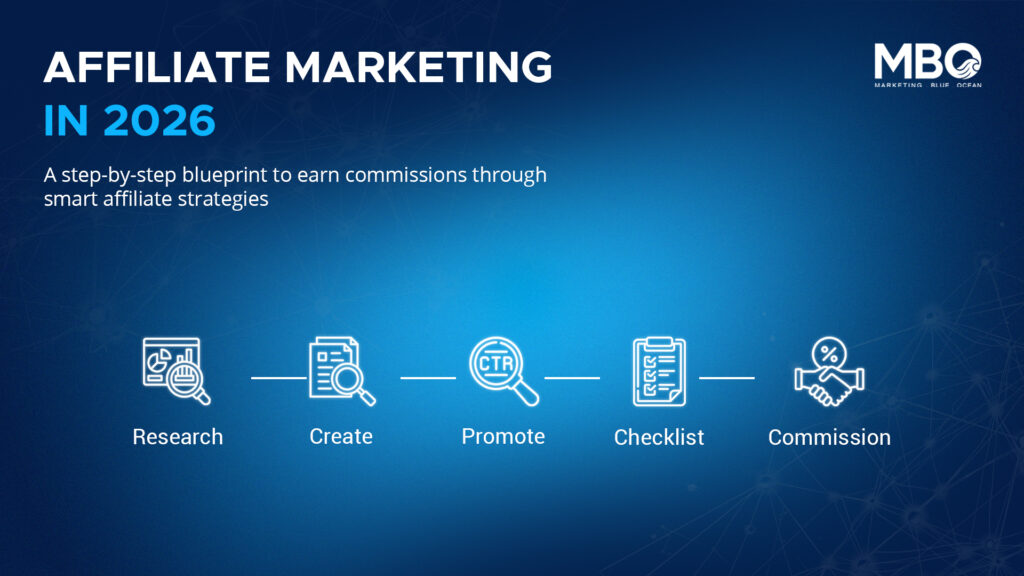
At first, it sounds techy, but it’s really not. Here’s the playbook, step by step:
Step 1: Join an Affiliate Program
First thing? Sign up for a program. Think Impact, ClickBank, ShareASale, Amazon Associates. Most are free. Once you’re in, you’ll see a catalog of products plus tools to help you promote.
Step 2: Select a Product Based on Your Niche
Don’t just pick up the first shiny thing you see. If you’re learning how to start affiliate marketing in 2026, picking the right niche is the first big step. Pick stuff that matches your vibe. Fitness blog? Go with protein powder or resistance bands. Tech nerd? Push gadgets or AI tools. Promoting random junk just makes you look desperate—and people can smell that from a mile away.
Step 3: Get Your Unique Affiliate Link
Here’s the magic: every product comes with a unique link that tracks your sales. Forgetting to use it = rookie mistake. No link, no money.
Step 4: Promote the Product (Without Being Annoying)
This is where the hustle happens. Spread your link through:
- Blog posts: Reviews, tutorials, “Top 10” lists.
- YouTube: Reviews, unboxings, and demos.
- Social media: TikTok, Instagram, Pinterest—you name it.
- Email: Build a list, send tips, and slide your links in naturally.
The key? Assist others, offer frank feedback, and only suggest products you would truly use. Trust beats spam every time.
Step 5: Earn Your Commission
Here’s the fun part. Someone buys → you get paid. Commissions range from 3–10% for physical stuff (Amazon), 20–50% for digital products, and even recurring payouts for subscriptions. Big-ticket items? You could pocket $100, $500, even $1,000 per sale. Stack those up, and you’ve got a real stream of passive income.
Affiliate Marketing Strategies in 2026 That Actually Work
Affiliate marketing in 2026 isn’t about spamming links; it’s about building trust. It isn’t just dropping links all over the place. It’s about timing, targeting, and not being annoying. Stuff that works:
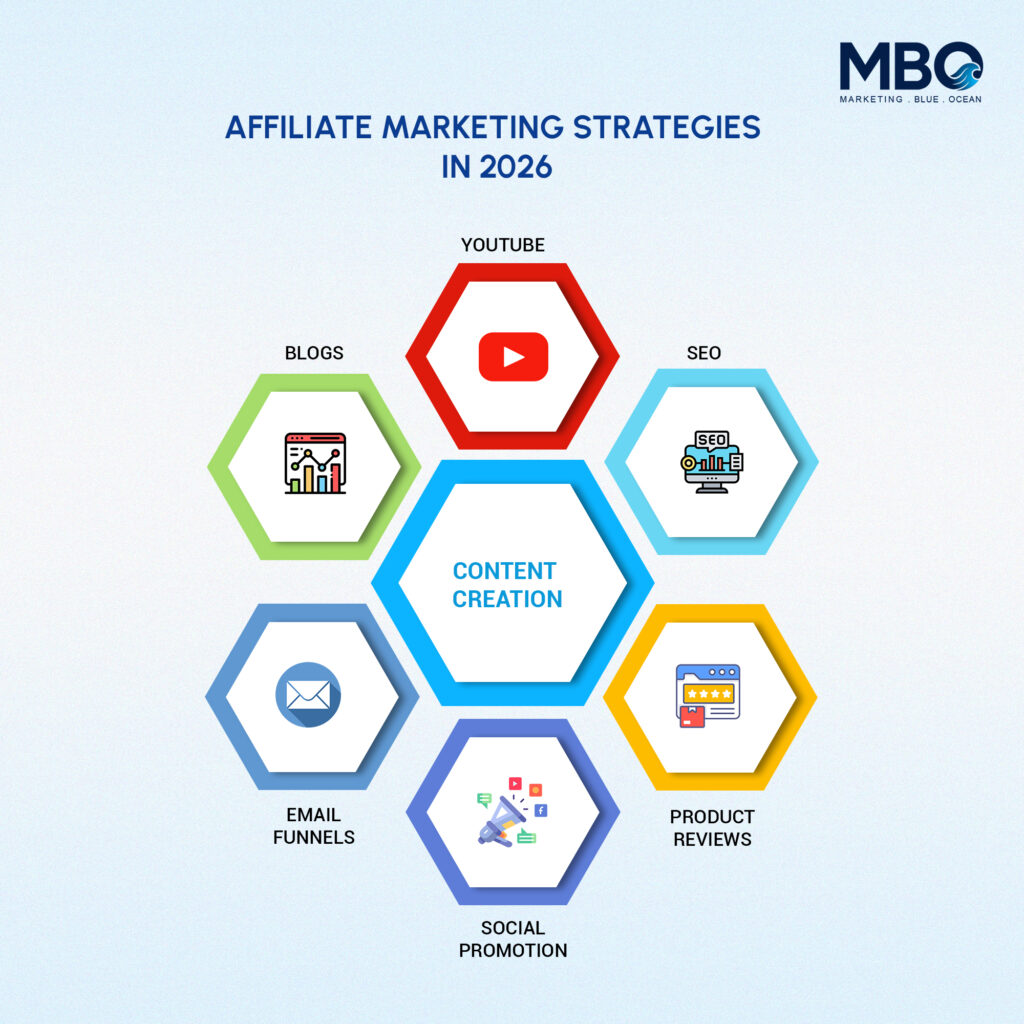
- Blogging with SEO
Blogging is the OG move. You write helpful stuff, get ranked in Google, and let the traffic roll in—sometimes for years.
How it plays out:
- Target keywords people are hunting for, like “best cheap laptops 2026” or “how to not mess up intermittent fasting.”
- Slide your affiliate links in naturally (nobody likes a hard sell).
- Amp up your SEO—use smart keywords, link to your own stuff, and get some backlinks.
Example: A travel blogger writes “Top 10 Travel Backpacks You Won’t Hate in 2026” and drops Amazon links to each one.
Why bother? Once it’s ranking, it’s basically passive income. You can be napping and still make sales.
And that’s the gist, really. Pick a good niche, find great affiliate stuff, make content that doesn’t suck, get traffic, and keep tweaking things till you’re making it rain. Easy? Nope. Possible? Absolutely.
- Email Marketing Funnels
Email marketing is like the OG power move for building real connections. Forget all those flaky social media algorithms—your email list? That’s all yours. No middleman telling you who sees your stuff.
Here’s the game:
You dangle a freebie—a little ebook, maybe a checklist, or even a bite-sized course. People trade their email for it. Boom, they’re on your list.
Now, don’t ghost them. Hit their inbox with newsletters. Share legit tips and cool guides, and maybe even slip in some product recommendations (not the spammy kind, please).
Set up an automated email sequence—so even if you’re off sipping coffee, your emails are out there shaking hands and building trust. THEN you drop those affiliate offers. Not before.
Like, say you’re into fitness. Offer a “7-Day Home Workout Plan” as your freebie, then follow up with emails about killer yoga mats, protein shakes, or that app you swear by.
Why does this work? Simple—folks on your list already care about your niche. They’re down to buy, way more than random scrollers.
- YouTube Tutorials with Affiliate Links
YouTube’s a beast. Second-biggest search engine, right? If you’re not on there, kinda feels like you’re leaving money on the table.
How you do it:
Make videos where you actually USE and talk about the product. Don’t just read the Amazon description—nobody wants that.
Drop your affiliate links in the description or pin ’em in the comments.
Get clever with your video titles, descriptions, and thumbnails so folks actually find your stuff (hello, SEO).
Like, if you’re a tech nerd, do a “Best Laptops for Students in 2026” video. Toss your Amazon or Best Buy affiliate links in the description.
People trust what they see on camera. A real demo? Way more convincing than a wall of text, trust me.
- Product Reviews & Comparisons
Let’s be real—when someone’s googling a review, they’re already itching to buy. They just want the final nudge.
How to nail this:
Write or film honest, deep-dive reviews about stuff you’ve actually tried.
Do head-to-heads, like “AirPods Pro vs. Sony WF-1000XM5—Which One’s Worth It?”
Break down pros, cons, prices, weird quirks, whatever. Sprinkle in those affiliate links where it makes sense.
For example, if you’re into software, write up “Top 5 AI Writing Tools in 2026 Compared” and link out to Jasper, Copy.ai, Writesonic…you get the idea.
People reading these? Already in “shut up and take my money” mode. Easiest conversions you’ll get.
- Social Media Promotions
Instagram, TikTok, Pinterest—they’re not just for memes and dance trends anymore. These places are goldmines for affiliate promos.
Here’s what you do:
Post Stories, Reels, or Pins showing off your fave products.
Jump on trends, use spicy hashtags, maybe collab with someone bigger than you for extra eyeballs.
Use your link in bio, story swipe-ups, or pin those links on Pinterest.
Say you’re a lifestyle influencer on TikTok—film a quick “Top 3 Affordable Skincare Products That Actually Work” and link out via Sephora or Amazon affiliates.
If one of your vids goes viral? Get ready for a flood of clicks and (hopefully) commissions. Fast money, if you’re lucky.
Different Affiliate Models You’ll Hear in 2026
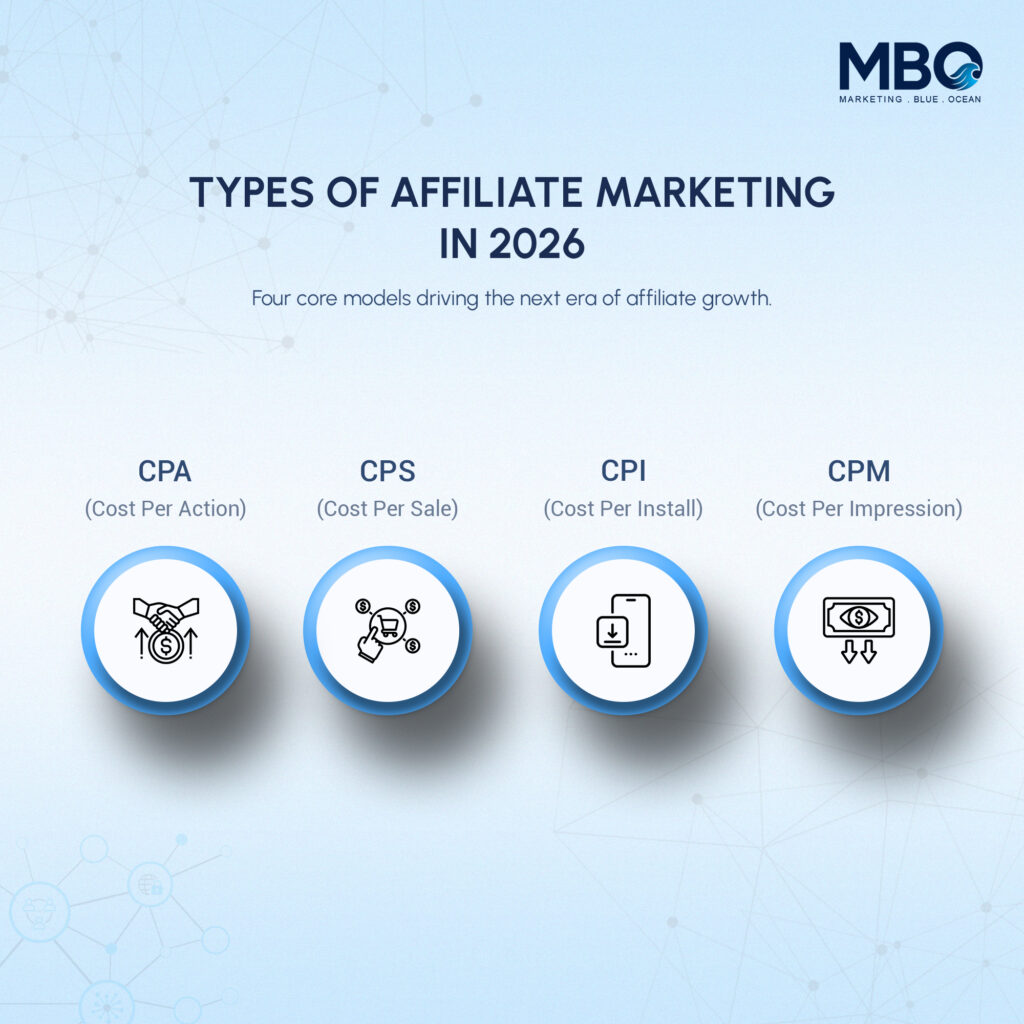
Affiliate marketing isn’t one-size-fits-all. Depending on your niche and audience, you’ll run into different models:
- CPA (Cost Per Action): Affiliates earn commissions only when a specified action is completed. Because it is a performance-based strategy, there is less risk because the advertiser only pays for outcomes. You get paid when someone takes an action, like signing up, downloading, or filling out a form.
Why it matters:Brands love CPA because they only pay when there’s measurable engagement. Affiliates like it because actions are often easier than sales (e.g., free signup vs. $100 purchase).
Example: A finance app pays you $5 every time someone signs up for a free account through your link.
Pros: You pay only when you get the desired action. Affiliates are strongly motivated by this pay-for-performance setup.
Cons: Commissions often must be higher to compensate affiliates, and affiliates assume more risk if the conversion is hard to get.
- CPI (Cost Per Install): Affiliates are paid for each installation of a mobile app. The affiliate’s link or ad must lead to an app download that the user opens. CPI is ideal for mobile apps (games, utilities, etc.) seeking new users. Big in the app world, you earn every time someone installs an app through your link.
Why it matters:The booming mobile economy (gaming, fintech, shopping apps) means there’s huge demand for installs. For affiliates with strong mobile traffic (social media, TikTok, app review blogs), CPI can scale fast.
Example: A gaming app might pay you $2 per install. If you run a TikTok channel reviewing mobile games, 1,000 installs = $2,000.
Pros: Targets actual users and is easy to track installs. Good fit for apps since you only pay for true installs.
Cons: Quality of installs can vary (some users may uninstall quickly). Apps can suffer from fake or incentivized installs if not monitored carefully.
- CPS (Cost Per Sale): Affiliates get paid when they drive an actual sale. Usually, commissions are a certain sum per order or a percentage of the sale price. This classic affiliate model (used by many retailers) works well for online stores and subscription services.
Why it matters:CPS is usually the highest-paying model because advertisers directly make money from the sale. Depending on the niche, commissions might vary from 5% to 50%.
Example: Promoting a $500 software with a 20% CPS commission = $100 per sale. Just 10 sales in a month = $1,000.
Pros: Directly ties payment to revenue; easy to calculate ROI. Affiliates often earn higher commissions on big-ticket items.
Cons: Advertisers must pay out of their profit margin; returns or chargebacks can reduce net revenue.
- CPM (Cost Per Mille): The “cost per thousand” method pays affiliates for every 1,000 times their ads are seen. The focus is on visibility, not actions. CPM is ideal for brand awareness campaigns on high-traffic sites or display networks. This works best when you already have solid traffic.
Why it matters: This is a common model in display advertising. If you run a website with high traffic, even if people don’t click or buy, you still earn for exposure.
Example: A blog with 100,000 monthly visitors could generate ad revenue purely through CPM deals. An advertiser would spend $500 for every 100,000 impressions if they paid $5 CPM.
Pros: Delivers wide reach for brand awareness. Advertiser can predict spend per thousand impressions.
Cons: No guarantee of clicks or sales; ads may be seen by uninterested users. There’s risk of “ad blindness” if audiences see the same ad too often
- Remarketing Campaigns (Re-Tagging): This is about targeting users who have already engaged with your brand. Affiliates (or the merchant) place tracking cookies when a user visits from an affiliate link. Later, ads are shown specifically to those users on other sites (display or social). One of the hottest 2026 moves. Conversions are greatly increased when you re-engage those who clicked on your link but did not make a purchase.
Why it matters:Remarketing drastically increases conversion rates. Instead of losing 90% of your potential commissions because people drop off, remarketing gives you a second (or third) chance to close the deal.
Example: You promote a skincare brand. A user clicks but doesn’t buy. Later, they see retargeted ads on Instagram reminding them of the same product and finally purchase it. You still get your commission.
Pros: Targets warm leads, so click-through and conversion rates tend to be higher. You make a second push to customers who are already interested.
Cons: Requires extra advertising budget and setup. Over-targeting can annoy users. Products with longer consideration cycles (subscriptions, education, etc.) benefit most from retargeting.
Pro Tip:
- Beginners often start with CPS (Amazon Associates, e-commerce) because it’s straightforward.
- Mobile/content creators lean toward CPI.
- For greater ROI, advanced affiliates like CPA + remarketing.
- CPM works best when you already have big traffic and need a passive revenue layer.
Types of Affiliate Marketing Models You Should Know in 2026
1. Black Hat Affiliate Marketing
Black Hat Affiliate Marketing refers to the unethical or manipulative practices affiliates use to game the system, often against the rules of networks, search engines, or platforms.
Some common tactics include:
- Cookie stuffing → inserting affiliate cookies without user consent so the affiliate gets commissions without genuine referrals.
- Cloaking → showing one version of content to search engines and another to users to rank unfairly.
- Fake traffic/bots → generating artificial clicks or impressions to trigger payments.
- Misleading ads → using false claims or deceptive creatives to push conversions.
Black hat practices nearly always result in penalties, account suspensions, and loss of trust, even though they may yield immediate results. In 2026, with AI-powered fraud detection by networks and advertisers, these practices are being caught faster than ever. The long-term, sustainable path is white hat affiliate marketing—focusing on trust, content quality, and authentic recommendations.
2. What Are Affiliate Networks?
The intermediary platform that links publishers (affiliates that promote products) and advertisers (companies with goods to offer) is called an affiliate network.
Why networks exist:
- They simplify the process by handling tracking, reporting, payouts, and compliance.
- For advertisers, networks provide access to thousands of affiliates instantly.
- For publishers, they offer a wide pool of programs in one place instead of applying brand by brand.
Top Affiliate Networks in 2026:
- Amazon Associates – Still the biggest, but commissions are low (often 1–3%). Works best for beginners.
- CJ Affiliate (Commission Junction) – Offers global brands, automation tools, and solid reporting.
- Following their merger, Awin & ShareASale had a sizable merchant catalog. Very beginner-friendly.
- ClickBank – Famous for digital products (eBooks, online courses) with commissions up to 75%.
- Rakuten Advertising – Premium network with trusted brands.
- Impact & Partnerize – Enterprise-grade networks with advanced tracking.
In 2026, AI-driven affiliate networks are emerging, offering smarter matching between affiliates and brands, fraud detection, and performance predictions.
3. Who Are Advertisers in Affiliate Marketing?
Advertisers (sometimes called merchants) are the businesses or brands that want to sell their products. They create affiliate programs and pay affiliates for driving traffic, leads, or sales.
Examples of advertisers:
- E-commerce brands like Nike, Apple, or Sephora.
- SaaS companies like HubSpot or Canva.
- Subscription services like Netflix or Spotify.
- Financial brands (banks, credit cards, insurance companies).
Advertisers decide on:
- The commission structure (CPS, CPA, etc.).
- The creative assets affiliates can use (banners, product images).
- The rules affiliates must follow (no spam, no bidding on brand keywords, etc.).
Without advertisers, there’s no affiliate marketing. They fund the ecosystem.
4. Who Are Publishers in Affiliate Marketing?
The individuals or businesses that promote advertiser products in return for commissions are known as publishers, or affiliates.
Publisher types for 2026:
- Bloggers and content producers compose listicles, how-to manuals, and product reviews.
- YouTubers and TikTokers can make money by promoting products in their videos and using affiliate links in their descriptions
- Users seeking discounts are drawn to coupon/deal websites such as Honey or RetailMeNot
- Email marketers run newsletters with affiliate recommendations.
- Comparison websites like Skyscanner or NerdWallet, which aggregate products and services.
In 2026, the rise of AI content tools has made publishers more powerful than ever. A single person can now run blogs, social accounts, and email funnels that look like a full-scale media business.
5. What Is Ad Inventory in Affiliate Marketing?
Ad inventory is the term used to describe the available advertising space that publishers own and make available to advertisers. Consider it the “real estate” on which affiliate marketing can be displayed.
Types of ad inventory:
- Display banners on websites.
- Native advertisements incorporated into blog posts
- Video placements on YouTube or TikTok.
- Podcast ad slots.
- Mobile app ad space.
Value of inventory depends on factors like
- Placement (above-the-fold ads are worth more than buried ones).
- Audience quality: a focused, active audience is worth more than a large, inactive one.
- Format (video and native usually perform better than static banners).
In 2026, inventory sales are real-time, targeted, and performance-driven thanks to programmatic advertising and artificial intelligence.
FAQs About Affiliate Marketing
- Does affiliate marketing require a website?
Nope, not required. You can totally hustle on YouTube, TikTok, Insta, or just via email. But having a website? Super helpful for looking legit, ranking on Google, and raking in that sweet long-term passive income. - Which affiliate niches are cash cows for 2026?
Chase after health & fitness, personal finance, AI tools/software, beauty & lifestyle, and online education. Those spaces are hot—tons of people searching, lots of good affiliate deals. - How long until you see results?
It’s a “how long is a piece of string” situation. Some folks get traction in 2-3 months; others grind for a year before seeing real cash. The trick? Don’t quit. Make content, push traffic, repeat.
Conclusion
Honestly, if you’re even a little bit curious, 2026 is prime time to jump into affiliate marketing. It’s flexible, you can scale it, and the earning potential is wild if you stick with it. Pick your niche, find a solid affiliate program, and get that first piece of content out there. Passive income isn’t just a myth—it starts with that first step.
Whether you’re hustling between classes, juggling a 9-to-5, or running your own thing, affiliate marketing gives you freedom and room to grow. Been thinking about starting? Why not now? Future you will thank you.
If you’ve been wondering how to start affiliate marketing in 2026f, the answer is simple: pick a niche, join a program, and take that first step.
Pro Tip: If you’re a business looking to scale, managing affiliates isn’t just about dropping links. It’s about handling the entire process, from strategy to campaigns to remarketing. That’s exactly what we at MBO do: end-to-end affiliate marketing solutions that actually deliver results.