Content creation is no exception to the fast-paced nature of the digital marketing industry. Businesses can no longer produce content using only conventional methods in 2026. Consumers demand speed, personalization, and relevance. Brands today rely heavily on AI tools for content marketing to scale faster. AI-powered content marketing solutions can help with that. From AI-generated blog posts to automated social media captions and real-time SEO insights, artificial intelligence is rewriting the rules of engagement. AI is now required if you want your brand to stay memorable, competitive, and visible. Many AI tools for content marketing automate research, content planning, and ideation, helping marketers create high-quality output faster. With AI tools for content marketing becoming mainstream, brands can now scale their content strategy effortlessly.

Modern AI content marketing tools help in creating, editing, and optimizing content at scale.In-depth discussions of the best AI content marketing tools, their advantages, and how they’re changing the entire process from ideation to publication, will be covered in this comprehensive guide.
Why AI Tools for Content Marketing Are Essential
The demands for content are overwhelming marketers, let’s face it. Delivering consistently high-quality content has become a full-time job and more due to the numerous platforms to manage, the short attention spans to contend with, and the ever-changing SEO algorithms. With the rise of AI tools for content marketing, teams no longer waste hours on repetitive manual work. Some of the best AI tools for content creation now support tone adjustment, brand consistency, and SEO insights. This is where AI tools for content marketing make the biggest difference.
AI tools for content marketing step in to:
- Automate laborious processes (such as writing, editing, and optimization)
- Instantly provide insights supported by data.
- Increase relevance and personalization on a large scale.
- Improve the performance of your content across all platforms.
More than 80% of top-performing marketing teams now incorporate at least three AI-powered tools into their daily operations, per a 2026 Gartner report. AI is now your new creative partner, not just a gimmick.
Benefits of Using AI Tools in Content Marketing
These AI tools for content marketing save hours every week and significantly improve workflow efficiency. AI-powered marketing tools can analyze user behavior and recommend content formats that perform better. It’s critical to comprehend the wider benefits of utilizing AI tools for content marketing before diving into particular platforms:
1. Quicker Creation of Content
Thanks to AI, tasks that used to take hours or days can now be finished in minutes. Need a blog post outline? A LinkedIn post? A headline for a landing page? AI takes care of everything, freeing up marketers’ time to concentrate on strategy and creativity. Let’s now examine the most potent and popular AI content marketing tools of the year, categorized by their primary functions.
2. Enhanced Personalization
AI delivers information that is customized for each user by analyzing purchase histories, engagement habits, and behavioral data. The result? enhanced conversion rates, increased retention, and better engagement.
3. Improved SEO Performance
Better SEO Results AI optimizes, not just writes. Numerous AI tools guarantee that your content ranks higher and faster, from keyword suggestions to SERP analysis and readability enhancements.
4. Optimization of the Budget
It can get expensive to hire writers, editors, strategists, and video editors. By supporting these functions rather than taking their place, AI lowers operating costs and makes premium marketing more accessible.
5. Consistency Across Channels
Maintaining a unified brand voice across blogs, emails, ads, and videos can be hard. AI tools allow marketers to standardize tone, language, and messaging at scale.
Top AI Tools for Content Marketing in 2026
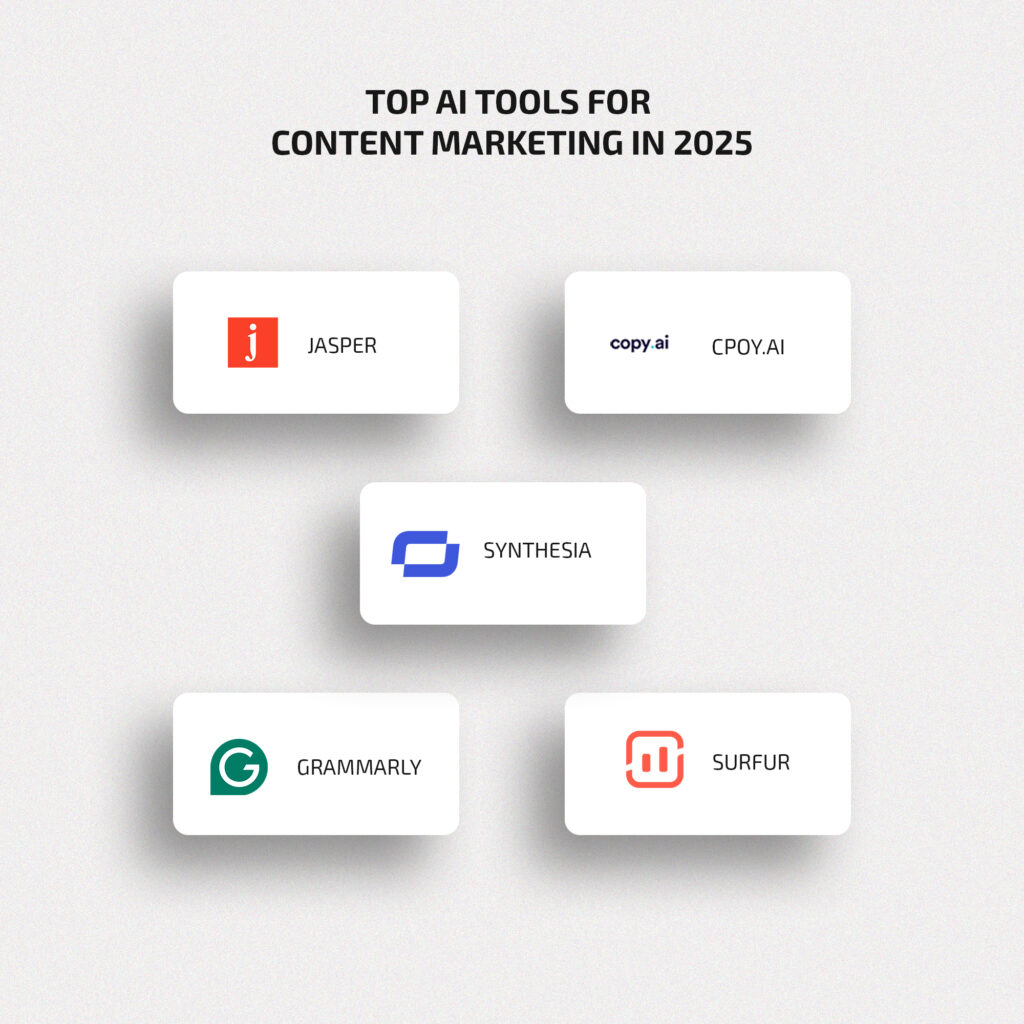
In 2026, content marketing will be more dynamic, tailored, and performance-driven, and AI tools have risen to the occasion to satisfy these changing needs. Artificial intelligence (AI) tools now cover every aspect of the content lifecycle, from automating the creation of long-form blogs to creating full videos, optimizing SEO, and personalizing ad copy. Popular AI tools for content marketing such as Jasper, Surfer, and MarketMuse streamline everything from writing to optimization. The best AI content marketing tools that are revolutionizing efficiency and outcomes are covered in detail below.
1. Jasper AI: Your Long-Form Content Partner Driven by AI
What it does:
Formerly known as Jarvis, Jasper AI has developed into the preferred long-form content creation tool for writers and marketers. This makes it one of the most reliable AI tools for content marketing in 2026. It creates comprehensive blog posts, e-books, landing pages, and marketing emails that are consistent with your brand after being trained on billions of data points.
Key Features:
- More than fifty pre-made content templates (emails, blogs, case studies, etc.)
- Customizable AI voice for brand coherence
- Integration of Surfer SEO for content optimization
- Teams can collaborate on documents in real time.
- Workflows for campaigns and automatic content growth
Why Marketers Love It:
Jasper doesn’t merely repeat content that has already been written. It learns over time through machine learning and comprehends subtleties such as your tone preferences, content objectives, and brand voice. Jasper expedites the process while improving quality, whether you’re creating SEO funnels or managing a blog calendar.
Best Use Cases:
- Technically accurate B2B blog content
- Articles that are optimized for search engines for inbound funnels
- Consistent messaging in email nurture campaigns
- Whitepapers and lengthy product explainers
2. Copy.ai – The Short-Form Conversion King
What it does:
When it comes to short-form, high-impact content, Copy.ai excels. It’s perfect for creating eye-catching ad copy, social media posts, product descriptions, and even catchy subject lines for emails. AI that has been optimized for conciseness and persuasion helps brands immediately capture attention.
Key Features:
- More than 100 marketing prompts, including slogans, value props, and ad hooks
- Tools for coming up with original ideas for CTAs, product names, etc.
- Creating content in bulk for workflows with a high volume
- Customizing AI tones for voice alignment
Why Marketers Love It:
Copy.ai is quick, easy to use, and innovative. In just a few minutes, even non-writers can produce content of a high caliber. It’s widely used by ecommerce stores, growth marketers, and agencies that need short copy on the fly.
Best Use Cases:
- automating product listings in Shopify stores.
- Ad creatives for Facebook and Instagram
- Hero headlines and sales landing pages
- Email subject line A/B testing
3. Surfer SEO: Boosting Rankings with AI
What it does:
What it does: Surfer SEO is a platform for content optimization that helps marketers produce articles that rank well by combining AI and SERP data. Although it doesn’t create entire articles, it provides your content team with data-supported suggestions gleaned from top-ranked rivals.
Key Features:
- Real-time on-page SEO score in a content editor
- SERP Analyzer for benchmarking keywords
- Clustering keywords using semantic analysis (NLP)
- Connects to CMS, Google Docs, and Jasper platforms
Why Marketers Love It:
It takes the guesswork out of SEO. Surfer tells you exactly what subheadings to include, how many words to write, and what keywords to use—based on current Google trends. Perfect for increasing SEO without the assistance of a strategist.
Best Use Cases:
- Creating blog posts with SEO from the start
- Updating out-of-date content to raise rankings
- Organizing topic clusters for content hubs driven by SEO
- Audits of content for SEO firms
4. GrammarlyGO: Improved Writing on Any Platform
What it does:
GrammarlyGO is a more sophisticated iteration of the traditional grammar checker. It rewrites sentences, enhances tone, and even drafts entire paragraphs in addition to correcting mistakes. This makes it one of the most reliable AI tools for content marketing in 2026. It is an effective tool for anyone who wants to refine content with accuracy and clarity.
Key Features:
- Rewrite the prompts according to the audience’s intentions.
- Modification of tone and style (formal, informal, self-assured, etc.)
- generating ideas for content using AI writing recommendations
- accessible within Slack, Gmail, Google Docs, and other programs.
Why Marketers Love It:
GrammarlyGO guarantees that your messages are received as intended in a world where tone is just as important as grammar. It guarantees top-notch writing on all platforms, whether it’s a team update, blog post, or professional pitch.
Best Use Cases:
- Thought leadership posts on LinkedIn
- Client correspondence and executive emails
- Editing blogs and QAing content
- Internal memos that are sensitive to tone
5. Synthesia: AI-Powered Video Production Without Cameras
What it does:
Synthesia gives brands the ability to create excellent videos without the need for actors, cameras, or studios. Marketers can quickly produce explainers, tutorials, and customized sales videos with AI avatars and natural-sounding voiceovers.
Key Features:
- 140+ AI avatars that can be customized
- Voiceovers in more than 120 languages
- Integration of screen and slide recording
- Making brand-specific avatars for big groups
Why Marketers Love It:
Video production expenses are reduced by more than 80% with Synthesia. You can now just type a script and select your avatar instead of hiring videographers or editing footage. It’s perfect for producing scalable, multilingual video content.
Best Use Cases:
- Tutorials for product onboarding
- Customized videos for B2B outreach
- Internal communications within the company
- Automation of YouTube channels
6. Market Muse: AI-Powered Strategic Content Planning
What it does:
Market Muse is a powerful strategic tool. Unlike generative tools, it focuses on research, planning, and performance optimization. It analyzes your entire site and competitor landscape to suggest what content to produce next for maximum ROI.
Key Features:
- AI content brief generation and optimization
- SERP-intent topic modeling and clustering
- Competitor analysis with topic gaps
- Predictive scoring for ranking potential
Why Marketers Love It:
It functions like a content strategist on autopilot. It helps teams prioritize high-ROI topics and measure performance over time. It helps enterprise brands scale SEO without squandering time or money.
Best Use Cases:
- Editorial planning for each month
- Analysis of the content gap on websites
- Strategies for scaling enterprise content
- Workflow management for multiple authors
Real-World Brands Using AI Tools for Content Marketing
AI is now a strategic tool being used by some of the largest and most reputable companies in the world, not just a playground for tech startups or creators. Enterprise teams are using AI tools for content marketing to scale multilingual video content and streamline blog creation, not only to save time but also to achieve new levels of creativity, efficiency, and personalization.
Let’s examine how big businesses are utilizing AI in 2026 as a primary driver of their content strategy rather than as a sidekick.
1. HubSpot – Scaling Inbound with AI-Driven Clustering and Optimization
HubSpot, a leader in CRM and content marketing, has incorporated AI into almost every stage of its content production process. By using natural language processing (NLP), HubSpot clusters blog topics based on user search intent, allowing them to plan content calendars with precision.
Additionally, they rewrite old content using AI tools to conform to current SEO trends, increasing visibility without having to start from scratch. This AI-powered refresh strategy has resulted in faster updates and sustained organic growth for a brand that publishes hundreds of blog posts every month.
2. Canva – Empowering Visual Creators with AI Copywriting
Although Canva is best known as a platform for designers, it is now also a major player in content marketing. Canva introduced its AI Copy Assistant in 2026. This integrated writing tool enables users to create headlines, descriptions, social media captions, and video scripts right within their designs.
Social media managers, solopreneurs, and small business owners can now create and write visually striking content without ever leaving Canva’s ecosystem.
3. Shopify – Powering Ecommerce Copy with Generative AI
With millions of merchants on its platform, Shopify introduced AI content automation features that generate product titles, descriptions, and SEO meta tags based on inventory data.
This is especially game-changing for merchants with large catalogs. Instead of writing descriptions for 300 products, they can now auto-generate high-converting copy that’s tailored to customer behavior and optimized for Google.
4. Coca-Cola – Producing Multilingual Video Campaigns with Synthesia
Global brands like Coca-Cola face a constant challenge: creating content for multiple markets in different languages. In 2026, Coca-Cola turned to Synthesia, an AI video generation platform, to develop a series of internal training and brand communication videos featuring AI avatars.
Without having to hire foreign talent or shoot in multiple locations, they were able to deliver the same messaging in more than 20 languages thanks to this tool.
5. Neil Patel Digital: Using Jasper + Surfer SEO to Scale SEO Content
Neil Patel Digital, a worldwide digital marketing firm, consistently leads the way in content trends. In 2026, they publicly integrated Jasper AI and Surfer SEO into their client content workflows.
While Surfer offers real-time SEO optimization to make sure every article is prepared to compete on Google’s first page, Jasper assists them in producing well-structured, brand-aligned content quickly.
Why This Matters for You
These victories are not minor ones. By incorporating AI tools for content marketing straight into corporate processes, these quantifiable, scalable changes are made possible. Brands that adopt AI tools for content marketing gain a competitive edge over those relying solely on manual processes.
- Startups use AI to build brand presence faster than their competitors.
- E-commerce companies to scale their product content at no marginal cost.
- Agencies to serve more clients without increasing their workforce.
- Lower the overhead of content creation and promote global consistency.
AI is always a growth multiplier rather than merely a tool.
The lesson learned? There’s no reason why you shouldn’t use AI to boost your content strategy if Fortune 500 companies are already doing so.
Challenges and Ethical Considerations When Using AI Tools for Content Marketing
While AI tools offer immense advantages, they come with limitations and risks that marketers must be aware of:
1. Risk of Generic or Robotic Tone
AI content creators usually lack emotional depth and artistic nuance. If left unedited, the output can feel dry, mechanical, or overly formal.
Solution: Use human oversight. Always have an editor or content strategist refine the AI-generated draft. Customize tone settings to match your brand voice.
2. Dependence on Prompt Quality
The effectiveness of AI tools for content marketing often depends on how well you prompt them. Vague inputs yield vague results.
Solution: Learn prompt engineering. The more detailed your instructions, the smarter and more accurate the content.
3. Risks of Plagiarism or Duplicate Content
If not set up correctly, certain AI tools may generate content that resembles that found in public sources.
Solution: To ensure originality, use plagiarism detection software (such as Copyscape or Grammarly). Add original stories and angles as well.
4. Brand Trust & Data Privacy
Concerns about trust and compliance may arise from AI-generated emails or chat responses, particularly in the legal marketing, healthcare, or financial industries.
Solution: When appropriate, disclose the use of AI and make sure the results adhere to legal and regulatory requirements.
5. Over-Reliance on Automation
AI cannot take the place of your imagination, compassion, or life experience. Your brand may become less human if you depend too much on automation.
Solution: AI a co-pilot. It should be used to supplement human storytelling, not to replace it.
FAQs:
1. What are content marketing AI tools?
Platforms or software that leverage artificial intelligence to automate or support the creation, optimization, analysis, and distribution of content are known as AI tools for content marketing. They enhance performance and content quality while lowering manual labor.
2. Can non-technical marketers or novices use AI tools?
Of course! The majority of tools have dashboards and templates that are easy to use. Technical expertise is not required; only specific content objectives and simple prompts are.
3. Is ChatGPT or Jasper better for marketing?
While Jasper is designed for marketing workflows and has pre-built templates for ads, landing pages, product descriptions, and more, ChatGPT is excellent for brainstorming and drafting. Jasper might provide more specialized tools if your goal is business outcomes.
4. Can my marketing team be replaced by AI tools?
No. AI enhances your team’s productivity but doesn’t replace the need for strategy, creativity, emotional intelligence, and cultural understanding. The best content still needs human oversight.
5. How can I make sure my content produced by AI appears in Google?
Optimize your content’s readability, keyword usage, and structure with AI tools like Clearscope, MarketMuse, and Surfer SEO. Additionally, make sure the page loads quickly, the backlinks are of high quality, and the content is relevant.
Conclusion:
By 2026, the battlefield of digital marketing will require speed, precision, customization, and creativity. It is now essential to incorporate AI tools for content marketing into your workflow, regardless of whether you are a B2B marketer, a solo entrepreneur, or the leader of a full-fledged content team. In 2026, companies using AI tools for content marketing will outperform competitors, simply because AI optimizes everything—from planning to publishing.
From Jasper for long-form writing to Copy.ai for ad copy, GrammarlyGO for editing, Surfer SEO for ranking, Synthesia for video content, and MarketMuse for strategy, AI can now support every stage of the content lifecycle.
However, keep in mind that a tool can only be as effective as the person using it. Be creative, curious, and eager to use AI to enhance rather than replace your voice. When used properly, AI can increase your reach, engagement, and results while also saving time and money.
If you’re still asking yourself whether AI is worth the effort, the answer is simple: brands that succeed in 2026 are not just producing content, they’re using AI to create it better, faster, and smarter.
So… what’s stopping you?
Along with using AI tools, avoiding basic SEO errors is important for ranking higher. Don’t forget to read my article on the Top 15 SEO Mistakes to Avoid for additional insights.