The Indian e-commerce industry is booming, and Amazon India stands at the forefront as the most trusted marketplace for millions of buyers. For entrepreneurs and small businesses, this creates a huge opportunity to sell online and grow nationwide.
To get started, sellers must meet certain legal requirements—most importantly, completing Sell on Amazon – GST Validated registration. A valid GSTIN (Goods and Services Tax Identification Number) and verified KYC are now mandatory for almost every category of sellers in India.
In this guide, we’ll walk you through the complete process of selling on Amazon with GST validation—covering eligibility, registration, compliance, benefits, and growth strategies for 2025.
Why GST Validation Matters for Amazon Sellers in 2025

India’s e-commerce ecosystem now demands full compliance with taxation laws to ensure fairness and transparency for both buyers and sellers. The Goods and Services Tax (GST) has introduced a uniform taxation framework across the country, making it mandatory for Amazon sellers who deal in taxable goods or operate across state or pan-India markets.
While the GST system has simplified India’s indirect tax structure, it has also introduced stricter compliance standards for online businesses. To align with these laws, Amazon requires every seller to provide a valid GSTIN (Goods and Services Tax Identification Number) and complete verification before listing any products. Without GST validation, sellers cannot legally operate or receive payments on the platform.
GST validation ensures:
Transparency in Taxation for Both Amazon and Sellers
One of the biggest advantages of GST validation on Amazon is the clarity it brings to taxation. Earlier, sellers faced confusion with multiple state-level taxes, making compliance a nightmare. With GST, Amazon ensures that every transaction—whether it’s a small order or bulk sale—is recorded with proper tax invoices. This transparency benefits both Amazon and sellers because it minimizes disputes, simplifies audits, and ensures that tax liabilities are calculated accurately. Sellers can also track how much tax has been collected and remitted, making financial planning more efficient.
Compliance with Government E-Commerce Regulations
The Indian government has tightened regulations around e-commerce platforms, requiring them to list only sellers who are GST-compliant. By validating GST numbers during seller registration, Amazon stays fully aligned with government mandates. This compliance not only prevents legal issues but also builds credibility for the platform. Sellers who list products with valid GST credentials operate within the legal framework, which protects them from penalties, fines, or account suspension in the long run.
Trust Among Customers Since Only Verified Sellers Can List
For customers, trust is everything when shopping online. GST validation acts like a quality check because it ensures that only verified sellers can list products on Amazon. Buyers know they are purchasing from a legitimate business that pays taxes and follows regulations, which reduces the risk of counterfeit or untrustworthy sellers. This level of assurance encourages more customers to shop confidently, boosting sales for compliant sellers while maintaining Amazon’s reputation as a reliable marketplace.
Eligibility for Input Tax Credit and Other GST Benefits
For sellers, being GST-validated unlocks significant financial benefits such as input tax credit (ITC). This means that businesses can claim credit for the GST paid on raw materials, packaging, or services used to sell their products. The ITC system prevents double taxation and reduces overall costs, directly improving profitability. Additionally, GST-compliant sellers become eligible for government incentives, business loans, and B2B partnerships—opportunities that are often unavailable to unregistered businesses.
Simply put, completing Sell on Amazon – GST Validated registration is the foundation of building a trusted and profitable seller account in 2025.
Eligibility Requirements for Sell on Amazon – GST Validated
Before starting your seller journey, make sure you meet Amazon India’s eligibility criteria for GST-validated sellers:
GSTIN Registration – Mandatory for Most Sellers Except in Specific Exempt Categories
To sell on Amazon India, a GSTIN (Goods and Services Tax Identification Number) is mandatory for almost all sellers. The only exceptions apply to categories that are exempt under GST law, such as books (other than e-books) and some unbranded food products. By making GSTIN compulsory, Amazon ensures that its sellers are recognized as legitimate businesses under Indian tax law. This registration not only allows sellers to legally operate on the platform but also makes them eligible for input tax credits, which help reduce tax liability. In short, GSTIN acts as the foundation of a compliant seller account.
Business Type – Flexibility Across Multiple Entity Structures
Amazon India allows sellers from a wide range of business backgrounds to register. Whether you are an individual entrepreneur, a sole proprietor, a partnership firm, a Limited Liability Partnership (LLP), or even a Private Limited Company, you can sell on Amazon. Each business type has slightly different documentation requirements, but the flexibility ensures that both small independent sellers and large enterprises can take advantage of Amazon’s massive customer base. This inclusivity has helped Amazon attract a diverse seller ecosystem, from home-based artisans to established national brands.
KYC Verification – Essential for Seller Onboarding
During registration, sellers must complete a Know Your Customer (KYC) verification process. This includes uploading critical documents such as PAN card, Aadhaar card, bank account details, and address proof. KYC ensures that only authentic and traceable sellers are listed on Amazon, which reduces the risk of fraud or non-compliance. For sellers, this verification adds credibility and shows customers that they are dealing with a legitimate business. For Amazon, it acts as a safeguard against fake accounts and malpractice.
Active Bank Account – Linked to the Seller’s Name or Business Entity
To receive payments from sales, sellers must link an active bank account with Amazon Seller Central. The account should be in the name of the seller or the registered business entity. This requirement ensures smooth payment settlements and compliance with financial regulations. Having a dedicated business account also helps sellers track their cash flow, manage expenses, and maintain a clear separation between personal and business finances. For new entrepreneurs, setting up a business bank account is often the first step toward building financial discipline.
Tax Compliance – Regular GST Return Filing is a Must
Registering with GST is only the first step—ongoing compliance is equally important. Sellers are required to file GST returns regularly, which means reporting sales, purchases, and taxes collected on time. Failure to do so can lead to penalties, suspension of GSTIN, and even account deactivation on Amazon. By staying compliant, sellers not only avoid legal trouble but also maintain their eligibility for benefits like input tax credit. Consistent filing also builds a positive compliance record, which can be useful when applying for loans, business partnerships, or scaling operations.
If you meet these requirements, you’re ready to start the Amazon seller registration process.
Step-by-Step Process: How to Register as a GST-Validated Amazon Seller in 2025
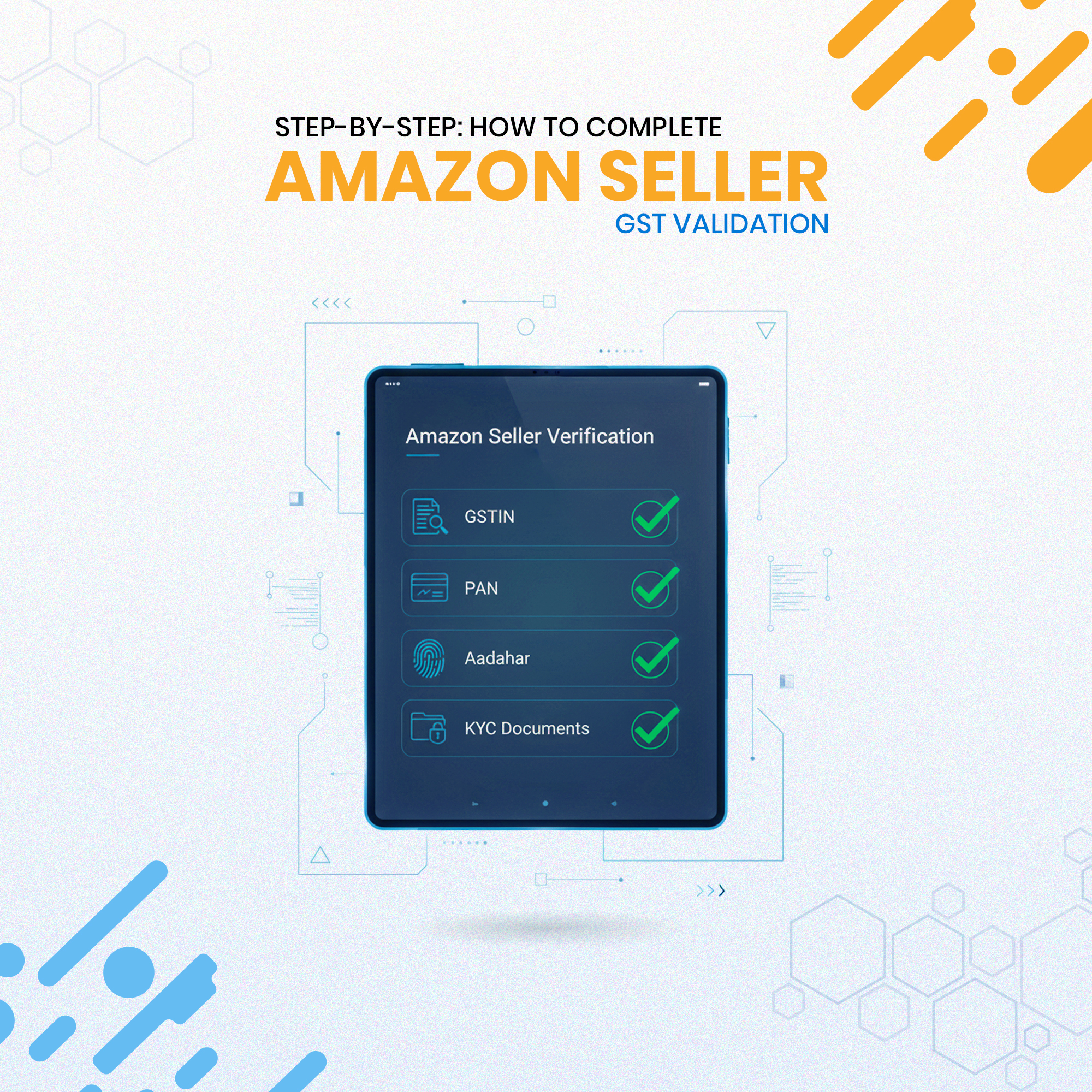
Getting started with Amazon India as a seller is easier than ever in 2025 — provided you follow the right registration and GST validation steps carefully. Amazon has simplified the onboarding process to help new entrepreneurs, small business owners, and established brands get started without confusion. Here’s the complete, step-by-step process to register and verify your GST-validated Amazon Seller Account successfully.
1. Visit the Amazon Seller Central Website
The journey begins at the official registration portal — Sell on Amazon India.
This is where you’ll find all the tools, resources, and instructions needed to start selling. The platform guides you through account setup, GST validation, and listing management. Always ensure you’re using the official Amazon India website to avoid any third-party scams or misinformation.
2. Create Your Seller Account
Once you’re on the Seller Central homepage, click on “Start Selling” to begin registration. You’ll be prompted to sign in using your email address and mobile number. If you don’t already have an Amazon account, create one.
Next, you’ll need to choose your business type, as Amazon allows multiple entity structures:
- Individual – for small-scale or home-based sellers.
- Proprietorship – for those running under their own legal name or a registered trade name.
- Company (Private Limited or LLP) – for medium to large businesses with a formal registration.
Your selected business type determines the documents you’ll need to provide in later steps.
3. Provide GSTIN and PAN Details
This is one of the most crucial parts of your registration.
During this step, you’ll enter your GSTIN (Goods and Services Tax Identification Number), which verifies your business as a registered entity under India’s GST law. Without a valid GSTIN, your account cannot be approved unless your category is tax-exempt (such as certain books or unbranded food items).
Alongside GSTIN, you must also submit your Permanent Account Number (PAN) — for both the business and the owner/director, depending on your entity type. Amazon uses this information to confirm your tax identity and link your business transactions to the correct tax records.
This stage forms the backbone of Sell on Amazon – GST Validated registration.
4. Add Business & Bank Information
Once your tax details are entered, you’ll move on to providing business and payment details. Amazon requires this information to process your payments smoothly and verify the legitimacy of your business.
You’ll need to fill in:
- Registered business name and address – as it appears on your GST certificate.
- Active bank account details – including account number and IFSC code.
- PAN details – of the business or owner, depending on registration type.
The name on your bank account must match your registered business entity or individual seller name. This ensures that sales earnings and refunds are deposited into the correct account without any delay.
5. Upload KYC Documents
The next step involves KYC (Know Your Customer) verification, which Amazon uses to confirm the authenticity of your business. Proper KYC documentation is mandatory for compliance with both RBI and government e-commerce regulations.
You’ll be asked to upload the following:
- PAN Card – to verify tax identity.
- Aadhaar Card – as government-issued identity proof.
- Business Address Proof – such as a utility bill, rent agreement, or property tax receipt.
- Cancelled Cheque or Bank Statement – to confirm that the bank account belongs to your business.
Amazon reviews these documents carefully to ensure that every seller on the platform is real, registered, and trustworthy. Any mismatch or incomplete submission may delay approval, so it’s important to double-check all uploaded files.
6. Product Categories and Listings
Once your KYC and GST details are verified, you can begin setting up your product catalog. Amazon allows sellers to list items across hundreds of categories, including fashion, electronics, home essentials, beauty, books, and groceries.
During this stage, you’ll need to:
- Choose appropriate product categories based on what you sell.
- Upload high-quality product images and detailed descriptions.
- Set pricing, inventory levels, and shipping preferences.
If you’re new to Amazon, start small — list a few products first to get comfortable with the Seller Central dashboard. You can always expand later once you understand how listings, orders, and reviews work.
7. Amazon GST Validation & Final Approval
After all the details are submitted, Amazon conducts an automated GST validation. Your GSTIN is cross-verified with the Government of India’s GST database to ensure accuracy and legitimacy.
This validation confirms that your GST number is active, correctly registered, and matches your business credentials. Once the verification is complete, Amazon sends an approval notification — officially marking your seller account as GST Validated.
From this point, you’re authorized to start selling on Amazon.in. You can list new products, receive orders, manage inventory, and begin earning through India’s largest e-commerce platform.
If any discrepancy is found (for example, mismatched business names or inactive GSTIN), Amazon may temporarily hold approval until the issue is corrected. Hence, it’s essential to keep your GST certificate, bank details, and KYC documents consistent across all submissions.
Pro Tip: Keep Compliance Updated
Your job doesn’t end after approval. To maintain your GST-validated Amazon seller status, you must continue filing GST returns regularly, update any business changes (address, bank, ownership), and renew licenses as needed. Staying compliant ensures uninterrupted access to selling privileges, faster payouts, and higher customer trust.
By following this step-by-step registration and GST validation process, you can establish a fully compliant seller account on Amazon India in 2025. It not only opens the door to millions of potential customers but also helps your business operate transparently and professionally within India’s digital commerce ecosystem.
Benefits of Becoming a GST-Validated Amazon Seller

Completing the Sell on Amazon – GST Validated registration doesn’t just make you compliant — it opens doors to a more trusted, scalable, and profitable business journey on India’s largest e-commerce platform. Here’s what you gain by becoming a GST-validated seller:
1. Wider Customer Reach
Once your GST and KYC are verified, you gain full access to Amazon’s massive national marketplace, reaching millions of active buyers across India. Amazon prioritizes verified sellers in search results and promotions, helping you attract more visibility, higher conversions, and faster sales growth — especially during high-traffic events like the Great Indian Festival or Prime Day.
2. Legal and Tax Compliance
Becoming GST-validated ensures your business operates legally under India’s GST framework. It simplifies tax filing and reporting, keeping you safe from potential penalties or account suspension. You’ll also find it easier to manage invoices, maintain transparency with buyers, and stay in sync with India’s evolving e-commerce tax policies.
3. Enhanced Credibility and Trust
Buyers on Amazon are more likely to purchase from sellers who appear verified and authentic. A GST-validated badge boosts your brand credibility, making your listings look more professional and reliable. It signals that your business follows proper taxation and quality standards — key factors in earning repeat customers and positive reviews.
4. Access to Premium Amazon Programs
Only GST-validated sellers are eligible to join FBA (Fulfilled by Amazon), Amazon Prime listings, and other exclusive seller programs. These services handle storage, packaging, and delivery on your behalf, improving logistics and customer satisfaction. They also increase your chances of earning the “Prime” tag — a major sales driver.
5. Eligibility for Input Tax Credit
A valid GSTIN allows you to claim Input Tax Credit (ITC) on business-related purchases, such as packaging materials, marketing expenses, or logistics services. This reduces your overall tax liability and improves your profit margins — an important financial advantage for both small and growing sellers.
Key GST Rules for Amazon Sellers in 2025
Selling on Amazon India means staying up to date with GST regulations. Here are the important rules sellers must follow:
- Compulsory GST for Online Sellers – No matter your turnover, GSTIN is mandatory if you sell on e-commerce platforms.
- TCS (Tax Collected at Source) – Amazon collects 1% TCS on sales, which gets reflected in your GST portal.
- Monthly Returns – File GSTR-1 and GSTR-3B every month.
- HSN Codes – Correctly classify products under Harmonized System of Nomenclature.
- Invoice Requirements – Every order must include a GST-compliant invoice.
Failure to comply can lead to penalties or account suspension.
Common Challenges in Amazon GST Validation
While Amazon’s GST validation process is straightforward, many sellers still encounter avoidable issues that can delay their account approval or even lead to rejection. Understanding these common challenges can help you prepare in advance and ensure a smooth registration experience.
1. Mismatched Details Between GSTIN and PAN
One of the most frequent problems arises when the information on your GSTIN certificate doesn’t match your PAN or business registration details. Even a small spelling difference in your name or business entity can trigger verification errors. Always ensure that your legal name, registered business address, and tax details are consistent across all official documents before submission.
2. Incorrect or Incomplete Bank Information
Amazon requires sellers to provide valid bank account details linked to their registered business name or proprietor’s name. Many applications face delays or rejection due to inaccurate IFSC codes, wrong account numbers, or mismatched account holders. It’s best to double-check your bank credentials and upload a clear, scanned copy of a cancelled cheque or recent bank statement for verification.
3. Blurry or Unclear Document Uploads
Document clarity plays a key role in Amazon’s KYC validation. If your PAN card, Aadhaar, or address proof is blurred, cropped, or poorly scanned, Amazon’s system might automatically reject your submission. Always upload high-resolution, readable files — preferably in PDF or JPEG format — to avoid unnecessary re-submissions.
4. Delay in GSTIN Verification with Government Database
Amazon cross-verifies your GSTIN with the GSTN (Goods and Services Tax Network), which connects directly to government databases. Occasionally, there may be a delay or mismatch in fetching your GST data, especially if it’s newly registered or recently modified. In such cases, sellers may need to wait for the government system to update or contact their local GST office for resolution.
5. Incomplete KYC or Missing Information
Sometimes, sellers forget to upload one or more mandatory documents such as business address proof or PAN details. Amazon treats incomplete KYC submissions as pending or invalid until all requirements are met. It’s crucial to carefully follow each step in the onboarding checklist provided by Amazon Seller Central.
Pro Tip: Preventing Delays
To ensure faster approval, review every field and document before submitting your application. Make sure your GSTIN, PAN, and business name are identical across all official records, and upload clear, legible files. Taking these extra few minutes can save you days of verification delay.
FAQs on Sell on Amazon – GST Validated
Q1. Is GST mandatory to sell on Amazon India in 2025?
Yes. Except for exempt categories like books, GST is mandatory for all sellers on Amazon.
Q2. Can I sell on Amazon without GSTIN?
No. Since Amazon is an e-commerce operator, GSTIN validation is compulsory before listing products.
Q3. How long does Amazon GST validation take?
It usually takes 2–5 business days if documents are correct and match government records.
Q4. What documents are needed for GST-validated registration?
PAN, Aadhaar, GSTIN, bank account proof, and address proof.
Q5. What happens if my GST number gets cancelled?
Amazon may suspend your seller account until a new GSTIN is updated and validated.
Conclusion
Selling on Amazon India in 2025 comes with immense opportunities, but it also requires compliance. Completing Sell on Amazon – GST Validated registration ensures you meet legal obligations, gain credibility, and unlock growth benefits like FBA and wider customer reach. From registering your GSTIN and completing KYC to listing products and growing with Amazon Ads, every step matters.
If you’re ready to grow in India’s booming e-commerce space, make sure your business is GST validated before you start. This one step will save you from compliance issues and set the foundation for a profitable Amazon journey.