
Introduction: The Question Every Business Owner Asks
If you’ve ever sat down to plan a paid advertising campaign, you’ve probably wondered: Should I go with Google Ads or Meta Ads?
It’s one of the most debated questions in digital marketing, and rightfully so. Both platforms have billions of users. Both promise incredible reach. And both can absolutely eat your budget alive if you use them wrong.
But here’s the thing is that Google Ads and Meta Ads are not competitors in the way most people think. They’re actually built for different jobs. And knowing which job to assign to which platform? That’s where the magic happens.
We’re breaking it all down here. Let’s see how these two ad giants work. And how smart businesses are using both to dominate their markets in 2026.
What Are Google Ads?
Google Ads (formerly Google AdWords) is a pay-per-click (PPC) advertising platform. It lets businesses show up exactly when people are searching for something on Google. Google is the world’s largest search engine.
When someone types “best running shoes under 3000 rupees” or “digital marketing agency in Mumbai,” Google Ads is what puts certain results right at the top of the page.
How Google Ads Work
- You bid on keywords relevant to your product or service
- Your ad appears when someone searches for those keywords
- You pay only when someone clicks on your ad (PPC model)
- Ads appear on Google Search, YouTube, Gmail, and millions of partner websites (Google Display Network)
Types of Google Ads
- Search Ads — Text ads that appear on Google search results
- Display Ads — Banner/image ads shown across websites
- Shopping Ads — Product listings with images and prices (great for e-commerce)
- YouTube Ads — Video ads shown before or during YouTube content
- Performance Max Campaigns — AI-powered campaigns across all Google channels
Google Ads is built on intent. The person searching is already looking for something. They have a problem, and they’re actively hunting for a solution. That’s an incredibly powerful moment to show up.
What Are Meta Ads?
Meta Ads is the advertising platform that runs across Facebook, Instagram, WhatsApp, and the Audience Network. With over 3.2 billion daily active users across Meta’s platforms, it’s the largest social media advertising ecosystem in the world.
Unlike Google, Meta Ads is built on interest and behaviour, not search intent.
How Meta Ads Work
- You define your target audience based on demographics, interests, and behaviours
- Your ads appear in users’ feeds, stories, reels, and sidebars as they scroll
- You can run awareness, engagement, lead generation, or conversion campaigns
- Meta’s algorithm uses machine learning to find users most likely to take your desired action
Types of Meta Ads
- Feed Ads — Image or video ads in Facebook/Instagram feeds
- Stories & Reels Ads — Full-screen vertical ads for mobile users
- Carousel Ads — Multiple images/products in a single swipeable ad
- Lead Generation Ads — In-platform forms to collect leads without leaving the app
- Retargeting Ads — Showing ads to people who’ve already visited your website or engaged with your content
Meta Ads is built on discovery. You’re reaching people who may not be actively searching, but who fit your ideal customer profile perfectly. Done right, it’s like finding your audience before they even know they need you.
Google Ads vs Meta Ads: The Key Differences
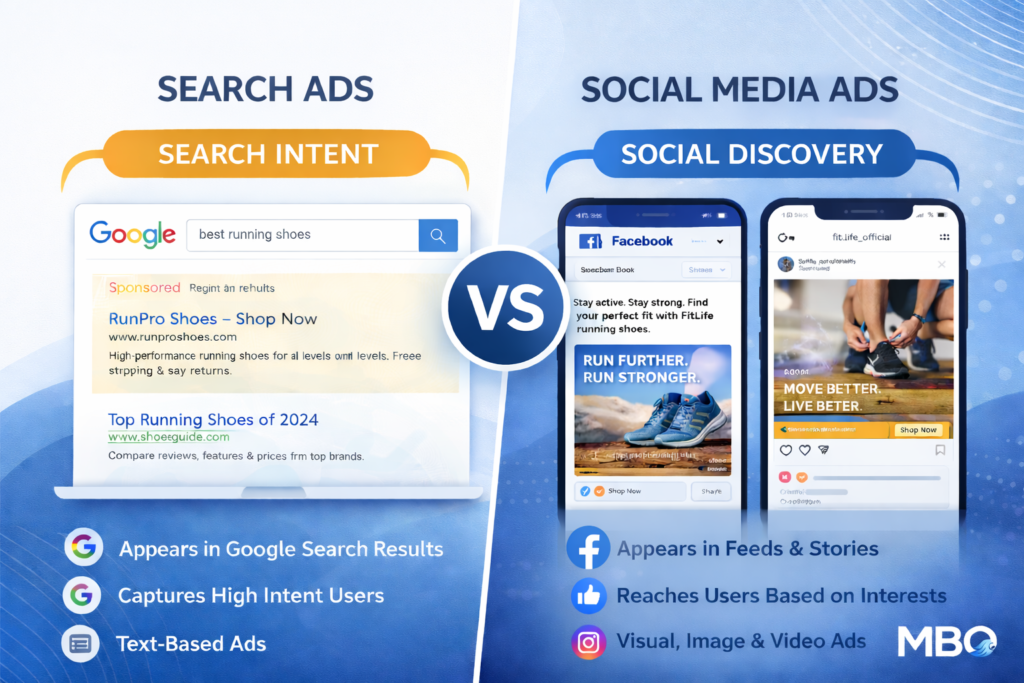
Here’s a clear breakdown of how the two platforms compare across the most important metrics:
| Factor | Google Ads | Meta Ads |
| Intent | High (active search) | Low-Medium (passive browsing) |
| Targeting | Keyword-based | Interest & behaviour-based |
| Ad Format | Text, Display, Video, Shopping | Image, Video, Carousel, Stories |
| Best For | Bottom-of-funnel conversions | Top & mid-funnel awareness |
| Average CPC (India) | ₹20–₹150+ depending on industry | ₹5–₹50 depending on audience |
| Competition | High in popular keywords | Lower for niche audiences |
| Creative Requirement | Moderate | High (visual-first) |
| Audience Size | Limited by search volume | Massive, highly customisable |
| Remarketing | Yes (GDN + YouTube) | Yes (very powerful) |
When to Use Google Ads
Google Ads works best when your potential customers are already aware of their problem and actively searching for a solution.
Use Google Ads If:
- You sell a product or service with clear, high-intent search demand. For example, “buy air purifier online” or “chartered accountant near me”
- You’re in a B2B space where buyers research extensively before making decisions
- You want to capture bottom-of-funnel leads ready to convert
- You run an e-commerce brand that wants to show products directly in search results via Google Shopping
- You want to dominate local search for your business (Google Local Ads are powerful for this)
Industries That Crush It on Google Ads:
- Legal services
- Healthcare and medical clinics
- Real estate and property
- Finance and insurance
- Home services (plumbing, electricians, pest control)
- SaaS and B2B software
If someone is typing exactly what you offer into a search bar, you absolutely need to be there. Missing that moment means your competitor takes that customer.
When to Use Meta Ads
Meta Ads shine when you need to build awareness, nurture an audience, or reach people who don’t yet know they want your product.
Use Meta Ads If:
- You’re a D2C brand selling lifestyle, fashion, beauty, food, or fitness products
- You need to build brand awareness in a new market or launch a new product
- Your product is highly visual. It looks good and sells itself when seen
- You want to run retargeting campaigns to bring back website visitors
- You’re targeting a specific demographic like an age group, interest, location, income level
- You want to generate leads at scale for lower cost than Google
Industries That Crush It on Meta Ads:
- Fashion and apparel
- Beauty and skincare
- Food and beverage (D2C)
- EdTech and online courses
- Health and wellness
- Real estate (awareness campaigns)
- Mobile apps and gaming
The visual, scroll-stopping nature of Instagram and Facebook makes Meta the best place to create emotional connection with your audience. If your brand has a story to tell, Meta is where you tell it.
The Real Cost Comparison: Which Is More Expensive?
This is where things get interesting and a little misunderstood.
On paper, Google Ads has a higher average cost-per-click (CPC) than Meta Ads. In competitive industries like legal or finance, a single click on Google can cost ₹200–₹500 or more. Meta clicks, on the other hand, can be as low as ₹8–₹15.
But here’s the catch: cost-per-click isn’t the same as cost-per-result.
Google clicks come from people actively searching. The conversion rate is typically much higher because the intent is there. So even though the click costs more, the journey from click to customer is shorter.
Meta clicks come from a more passive audience. They might need to see your ad 3–5 times before they convert. Your cost per lead or sale may end up similar or even higher especially for B2B purchases.
The Bottom Line on Cost:
- Google Ads = Higher CPC, higher intent, faster conversions for bottom-funnel goals
- Meta Ads = Lower CPC, lower intent, better for awareness, retargeting, and visual products
- Real ROI depends on your industry, offer, audience, and how well your campaigns are optimised
This is exactly why a one-size-fits-all answer to “which is cheaper” is misleading. What matters is your cost per acquisition (CPA) not the click cost.
Targeting: Where Each Platform Wins
Google’s Targeting Strengths:
- Keyword intent targeting — show up for the exact moment someone searches
- Location targeting — hyperlocal down to a pin code or city
- Audience targeting — in-market audiences, custom intent, life events
- Remarketing — re-engage website visitors with display and YouTube ads
- Device targeting — mobile vs desktop optimisation
Meta’s Targeting Strengths:
- Interest and behaviour targeting — reach people based on what they follow, like, and engage with
- Lookalike Audiences — find new users who behave like your best existing customers
- Custom Audiences — upload your customer list and target them directly
- Demographic precision — age, gender, relationship status, income level, parenting status
- Detailed engagement targeting — people who engaged with your videos, page, or website
Here’s a practical way to think about it: Google finds the buyer at the right moment. Meta finds the right person at any moment.
The Power Move in 2026: Using Both Together
Here’s what the most successful brands in 2026 have figured out. It’s not Google Ads vs Meta Ads. It’s Google Ads and Meta Ads working as a system.
A Smart Full-Funnel Strategy Looks Like This:
- Awareness (Top of Funnel) → Use Meta Ads to introduce your brand, run video campaigns, tell your story, build an audience
- Consideration (Middle of Funnel) → Use Meta retargeting to re-engage people who visited your site, and Google Display to stay top of mind
- Conversion (Bottom of Funnel) → Use Google Search Ads to capture people who are now ready to buy and are actively searching
- Retention (Post-Purchase) → Use Meta and Google remarketing to bring customers back, upsell, and build loyalty
This approach ensures you’re reaching your audience at every stage of their buying journey. The brands doing this well are seeing significantly lower customer acquisition costs and higher lifetime value.
Common Mistakes Businesses Make With These Platforms
Before you go all in, here are the traps most businesses fall into:
- Running Google Ads with no keyword research: bidding on broad terms that drain budget without converting
- Using Meta Ads for high-intent, ready-to-buy campaigns: the audience isn’t in buying mode yet
- Ignoring creative quality on Meta: bad visuals = terrible performance, regardless of targeting
- Not setting up conversion tracking properly: flying blind without data is one of the most expensive mistakes
- Giving up too soon on Meta Ads: the algorithm needs time (and data) to optimise; quitting after a week is premature
- Choosing one platform forever: your business needs evolve; so should your channel mix
So, Which One Should YOU Choose?
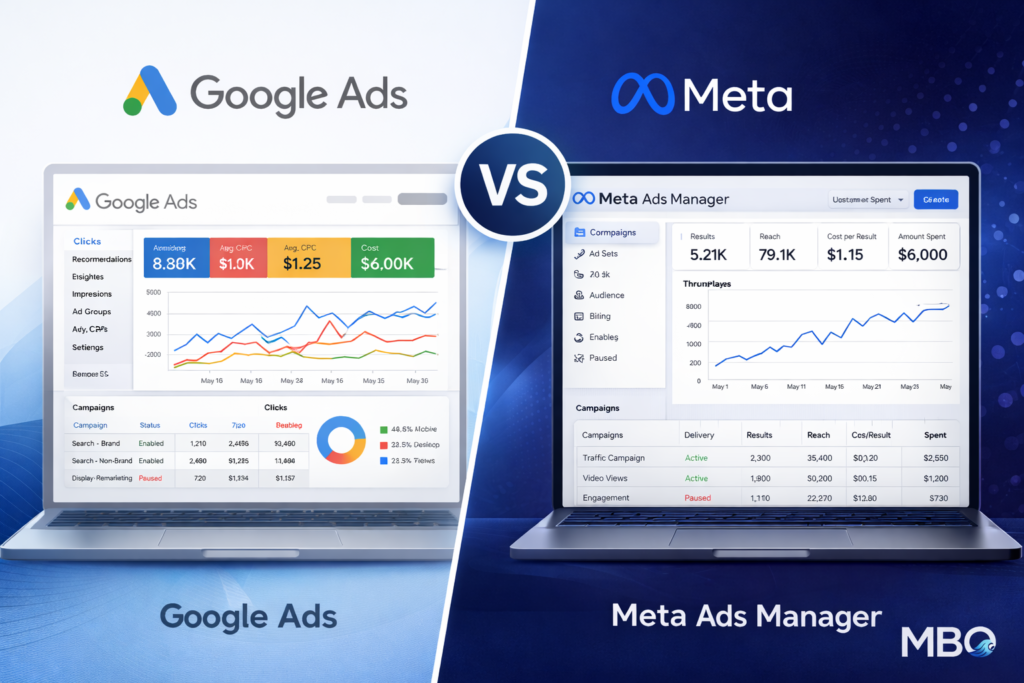
Here’s our honest take:
- If your customers are actively searching for what you offer → Start with Google Ads
- If your product is visual, lifestyle-driven, or discovery-based → Start with Meta Ads
- If you have the budget and want to grow fast → Use both with a clear funnel strategy
- If you’re a startup or small business on a tight budget → Pick the one that aligns with where your buyer is in their journey, nail it, then expand
There’s no universally “better” platform. There’s only the right platform for your specific goal, audience, and budget. Right strategy is also important to make it work.
Final Thoughts
The Google Ads vs Meta Ads debate will keep going because both platforms genuinely work. The businesses winning in 2026 aren’t the ones who picked a side. They’re the ones who understood the role each platform plays in their customer’s journey and built campaigns accordingly.
Whether you’re a D2C brand trying to scale on Instagram, an e-commerce store wanting to dominate Google Shopping, or a B2B company looking for qualified leads and the answer lies in strategy, not platform loyalty.
Pro Tip: At Marketing Blue Ocean (MBO), we specialise in multi-channel performance marketing across Google, Meta, Amazon, and beyond. From campaign strategy to creative to optimisation. We handle it all with one goal in mind: real, measurable growth. Let’s talk.
